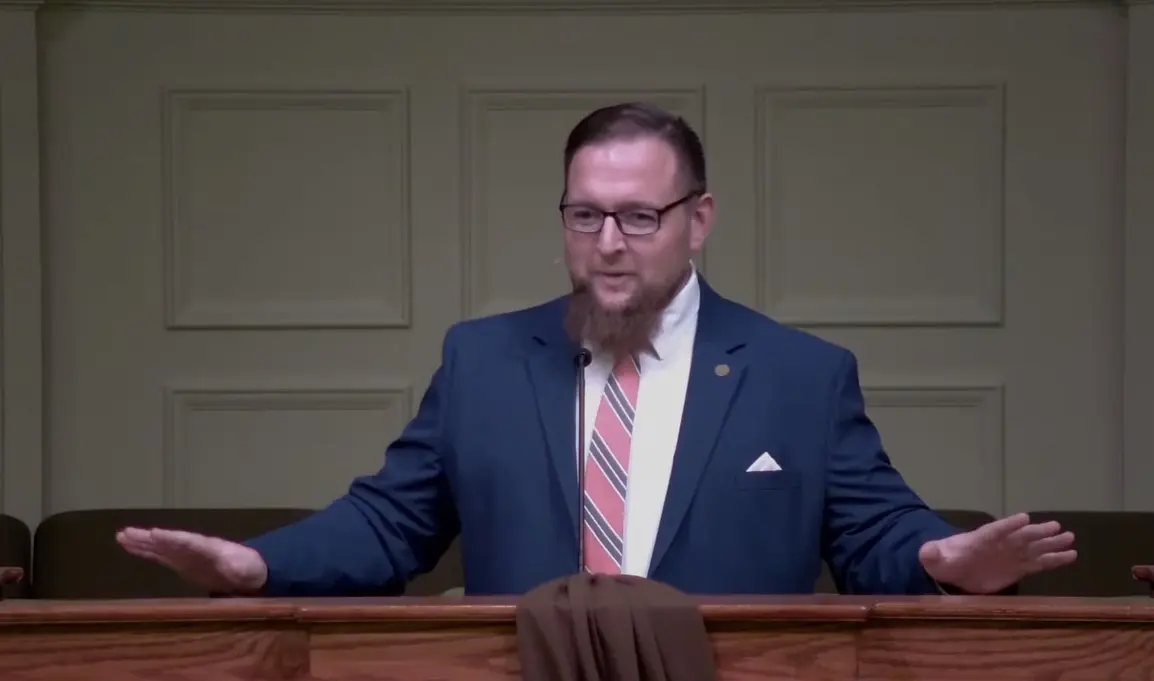
Video
“The Good Shepherd Pt. 1”
John 10:11-21
Pastor Ryan J. McKeen
10/18/2026
Audio
Transcript
Amen. I had the privilege this week of visiting with Shirley Marsteller’s family after she went home to glory today and we were reminiscing about Dave and Shirley and how we miss them. I miss seeing them. I miss seeing them at church every time the doors are open. I miss Shirley, I miss seeing Shirley sitting right there in the middle, correcting my grammar as I’m preaching, mouthing back to me how I should have said it. I miss their kind words and their hugs, and I remember the first time we came down here to candidate, and I was here to preach a couple times and to get to know everyone, and I remember from that very first time, I knew they loved me. I knew it, and I knew it every time that I saw them. They loved me, and I miss Dave and Shirley, but I don’t want them back. I don’t want them here. What a wonderful Lord’s Day Shirley’s having this morning, face-to-face with her Savior.
Well, turn with me in your Bibles to John chapter 10. John chapter 10, we’re back in John 10 this morning. Back in this magnificent chapter of God’s word. This rich, deep, tremendous chapter of God’s word. A chapter that tells us so much about our savior. About our salvation. And last time we came to the first mention of Jesus as the good shepherd.
The Bible uses a lot of titles for Jesus, dozens of them. Titles that all tell us something about Him. Titles that tell us what He is and what He’s like and who He is. And John himself is writing to convince us of two of the titles of Jesus, that He is the Christ and He is the Son of God. John also records numerous I Am statements and sayings of Jesus, sayings which Jesus uses to explain who He is. We’ve already seen that Jesus is the bread of life, that He’s the light of the world. A few weeks ago, we saw that He is the door.
Not to mention all the many times Jesus just plainly and simply claimed to be the I Am. In John chapter 10, here in verse 11 of John chapter 10, Jesus mentions another title of his. Dr. John MacArthur commented that this is perhaps his most endearing and intimate title. And of course, I’m talking about Jesus using his self-given title, the Good Shepherd.
As we began looking at this last week, we paused and did a deeper study of verse 11 by itself, where we saw the goodness of the shepherd and the sacrifice of the shepherd and the intent of the shepherd, all from verse 11. And we’ll briefly review those things a little later on, but as I was studying this text this week, really verses 11 through verse 21, where Jesus reveals and explains himself as the good shepherd all the way through, because it is all one, I really wanted to treat this passage all together. And I studied through and outlined and pulled out all of the realities Jesus reveals about the good shepherd in these verses. And as one of you commented this morning, oh, we’re doing a bunch of verses today.
As I was putting all of this into one sermon, I realized that I had 12 points for that sermon. Calm down. Don’t go anywhere. That’s why in your bulletins, the title of this sermon is The Good Shepherd Part One. I didn’t think I could cover 12 points all in one sermon, at least if I wanted anyone to still be here at the end.
But we will start this study of the Good Shepherd this morning. This will be part one of how many parts I don’t know yet. I’m hoping to, but we’ll see. And just so you can see where we’re going in this study, these are the 12 realities that I’ve found digging into this text, these 11 verses of Jesus talking about himself as the good shepherd and all that that means. These are the 12 realities that I’ve pulled together.
And first of all, as we’ve already seen, number one, the shepherd is good. The shepherd is good. And secondly, the shepherd owns. Thirdly, the shepherd protects. Fourth, the shepherd is concerned. Fifth, the shepherd knows. Sixth, the shepherd is known. Seventh, the shepherd gathers. Eighth, the shepherd calls. Ninth, the shepherd unites. 10, the shepherd is loved. 11, the shepherd has authority. And 12, the shepherd divides. All of that found in this one passage. 12 points in 11 verses. I told you this was a rich passage. Well, before we get any further, allow me to read this passage for us. John chapter 10 verses 11 through 21. This is the word of the Lord.
I am the good shepherd. The good shepherd lays down his life for the sheep. He was a hired hand and not a shepherd who is not the owner of the sheep, sees the wolf coming and leaves the sheep and flees. and the wolf snatches and scatters them. Because he is a hired hand and is not concerned about the sheep. I am the good shepherd.
I know my own and my own know me. Even as the father knows me and I know the father. And I lay down my life for the sheep. And I have other sheep. which are not from this fold. I must bring them also, and they will hear my voice, and they will become one flock with one shepherd.
For this reason the Father loves me, because I lay down my life so that I may take it again. No one takes it away from me, but from myself, I lay it down. I have authority to lay it down, and I have authority to take it up again. This commandment I received from my father.”
A division occurred among the Jews because of these words, and many of them were saying, he has a demon and he is insane. Why do you listen to him? Others were saying, these are not the words of someone demon possessed. Can a demon open the eyes of the blind?
That is the Good Shepherd. I guess we need to get started on these 12 points. The first reality that Jesus shows us is that the shepherd is good. The shepherd is good. Again, verse 11, I am the good shepherd. The good shepherd lays down his life for the sheep. Again, we studied this in depth last week. He reiterates for us twice that he is the good shepherd. It’s not just that he’s the shepherd of the sheep, he is a good shepherd. And this is worth pausing and considering once again, how he is the good shepherd.
Long before he arrived in Jerusalem and stood before these Jews, God had promised that a shepherd was coming. Now, God Himself is the Shepherd of Israel. We see that in Psalm 80 as we’ve seen before. Psalm 80 verse 1 says, O Shepherd of Israel, give ear. You who guide Joseph like a flock, you who are enthroned above the cherubim, shine forth. Who’s enthroned above the cherubim? It’s God. He is the Shepherd of Israel.
But He also promised to send one. to send one that would shepherd for him. We see this in several places. In Ezekiel 34 verse 23, then I will establish over them one shepherd, my servant David, and he will shepherd them. He will shepherd them himself and be their shepherd. And as was read earlier, Micah prophesied of one who would, in verse 4 of Micah chapter 5, stand and shepherd his flock in the strength of Yahweh, in the majesty of the name of Yahweh his God. And they will remain because at that time he will be great to the ends of the earth.
Prophet Zechariah spoke of shepherds a lot. He had much to say about the false shepherds of Israel. Those who were supposed to shepherd for God and failed. Zechariah chapter 11, starting in verse 15, Yahweh said to me, take again for yourself the equipment of a foolish shepherd. For behold, I’m going to raise up a shepherd in the land who will not care for those who face annihilation.
Seek the young, heal the broken, sustaining the one standing, but will consume the flesh of the fat sheep and tear off their hooves. Woe to the worthless shepherd who forsakes the flock. A sword will be on his arm and on his right eye. His arm will be totally dried up and his right eye will be totally dimmed.
And then following that warning, Zechariah reveals there’s another shepherd. There’s another shepherd that is coming, one who will come and shepherd the people rightly. and would be struck down for it.” A couple chapters later in Zechariah 13, verse 7, the prophet says, “‘Awake, O sword, against my shepherd, and against the man my associate declares Yahweh of hosts. Strike the shepherd that the sheep may be scattered, and I will turn my hand against the little ones.’” And then, as the New Testament period begins, this shepherd is revealed. This one that was promised to come and rule and shepherd the people rightly. The son of David. It’s Jesus. We see that in Matthew 5. When Herod is asked, or when asked by Herod where the Messiah would be born.
And we see in Matthew chapter 2 as well in verse 6, the chief priests and scribes quote from Micah and say, you Bethlehem, land of Judah, you are by no means the least among the leaders of Judah, for out of you shall come forth a leader who will shepherd my people. And when he was telling his disciples how they would flee from him, how they would scatter, how they would desert him in his time of need. In Matthew 26, 31, Jesus quotes the prophet Zechariah and says, you will all fall away because of me this night. For it is written, I will strike the shepherd and the sheep of the flock shall be scattered.
Jesus is showing them. That shepherd that was promised to come is here. Peter described Jesus as the shepherd of believers’ souls. First Peter 2.25, you were continually straying like sheep. But now you have returned to the shepherd and overseer of your souls. And we’ve read many of the other passages where Peter calls Jesus the chief shepherd. In Hebrews, Jesus is called the great shepherd. And even in Revelation, where it’s revealed that the lamb will shepherd his people and guide them to springs of water and of life. And God will wipe away every tear from their eyes. He is the Good Shepherd. How is He good? Well, how is He not good? He is good in every sense of the word, good. He is perfect and without sin, which means He can be the only one. He alone is qualified to be the sacrifice that paid for our sin.
Comparison to the bad shepherd’s good. He feeds the sheep. He cares for the sheep. He protects the sheep. He loves the sheep. And most importantly, as we saw, what demonstrates that he is the good shepherd is what he tells us himself. Again, John 10 verse 11, the good shepherd lays down his life for the sheep. He lays down his life for the sheep because he loves the sheep. Greater love has no one than this, than he who lays down his life for his friends. We’ve already covered all of these things. That was all just review, so I won’t belabor that first point anymore, but number one, the shepherd is good. Boy, is he good.
Number two, we see that the shepherd owns, meaning that he’s the owner of the sheep. And this is in comparison to a hired hand who does not own the sheep. Verse 12, he who is a hired hand and not a shepherd, who is not the owner of the sheep, sees the wolf coming and he leaves the sheep and flees and the wolf snatches and scatters them. Earlier in his illustration, Jesus compared the Jewish leaders to thieves and robbers, and thieves and robbers are obviously evil and have evil intentions for the sheep. Here Jesus mentions the hired hand, or in the KJV, the hireling. Again, this is in comparison to these leaders of Israel, the false shepherds. but it also has relevant comparison to many false shepherds today.
A hired hand is simply there for the paycheck. He’s there for what he can get out of it. He’s there for him. This is a job. Again, this illustration is very relevant to me growing up on a farm. Growing up, taking care of animals. In my case, it was cows and not sheep. But the principle’s the same. Growing up on the farm, we had our fair share of hired hands. And there are good hired hands and there are bad hired hands.
But at the end of the day, no hired hand cares for the animals quite like the owner does. The owner was there when the animal was born. The owner raised these animals. The owner has something invested in these animals. If the animals aren’t well cared for, it costs the owner. But the hired hand still gets a paycheck at the end of the day. And if he’s a bad hired hand and gets fired, he can just move on to the next job that’ll pay him. But the owner stays. The owner stays with the same animals. And the future of his herd lives or dies with these animals. So a good owner pays attention and cares for the animals.
And that’s what Jesus is saying here. Unlike these hired hands who run away when the going gets tough, he is the good shepherd who stays with the sheep because he owns the sheep. Before we move on, think about that. Think about that. If you are His sheep, He owns you. You are His. He will never leave you or forsake you. He purchased you. He has a vested interest in you. So He will be with you. And he will make sure you get through whatever hardship you’re going through. Whatever wolf is in your life, the shepherd’s still here. You are an owned sheep. You are owned by the good shepherd.
And because he owns you, he is your Lord and your master. You owe obedience to him. You don’t make Jesus the Lord or Master of your life. You don’t have that authority. He is the Lord and Master of your life if you are His. If He was just another hired hand, you could choose whether or not He’s worthy to obey. But He’s the owner of the sheep. He is worthy. He purchased you. And he is good. That’s number two. The shepherd owns his sheep. And because he owns his sheep, that means, number three, the shepherd protects. The shepherd protects his sheep.
Again, from verse 12, he who is a hired hand and not a shepherd, who is not the owner of the sheep, sees the wolf coming and leaves the sheep and flees. And the wolf snatches and scatters them. The shepherd does what the hired hand does not. The hired hand runs and lets the wolves snatch and scatter, and the wolves will come. That’s not a question. There are real dangers in life for believers.
1 Peter 5.8, your adversary, the devil, prowls around like a roaring lion seeking someone to devour. The devil’s prowling around. And there are other dangers out there, the temptations of the world, the snares and traps of sin that lurk around every corner. Desires for money, for approval, for power, for comfort, for pleasure. There are any number of things out there that a careless sheep can get his nose caught in.
And if it was left up to worthless hired hands, to keep you safely in the flock of God, to keep you from falling away and losing your salvation. If it was up to them, then you would. If it was up to them, whether or not you lose your salvation, you would. If it was up to you, whether or not you would lose your salvation, you would lose it.
Because we’re sheep. Sheep are dumb. And that’s the point here. The sheep don’t keep themselves close to the shepherd. The shepherd gathers them and keeps them and protects them. It’s not up to you to keep your salvation. Listen to what Jesus, the good shepherd, says later on in this very same chapter. Look down to starting in verse 26. but you do not believe because you’re not my sheep. My sheep hear my voice, and I know them, and they follow me, and I give eternal life to them, and they will never perish ever. And no one will snatch them out of my hand. My Father who has given them to me is greater than all, and no one is able to snatch them out of the Father’s hand. No one will snatch them.
It’s the Greek word harpazo. which is the same word that we get the word rapture from. It means taken by force. And he says it twice so you don’t miss it. And it’s the same word snatch that was used in verse 12. Speaking of the dangers to the sheep. The wolves come to snatch. And Jesus says, no one. Not one of my sheep will be snatched away. If it were up to anybody else, the wolves would snatch you up. But it’s up to the good shepherd. So no one will snatch any of his sheep. This was Paul’s confidence. If anyone faced the danger of the wolves and everything else in life, it was Paul. He was constantly running for his life. He had to escape more than one city so that he wasn’t snatched up.
But listen to Paul’s words. Turn quickly with me to 2 Timothy. These are so important and worth you reading through. 2 Timothy chapter 4. Starting in verse 17, this is Paul’s confidence, Paul who faced more dangers than you can number. 2 Timothy chapter 4 verse 17, but the Lord stood with me and strengthened me so that through me the preaching might be fulfilled. and that all the Gentiles might hear. And I was rescued out of the lion’s mouth. The Lord will rescue me from every evil deed and will save me unto his heavenly kingdom. To him be the glory forever and ever, amen.
Paul was a sheep. Paul was one of his sheep. And Paul was in danger of being snatched up. But the Lord stood with me. Paul had his confidence in the Lord who stood with him. Paul’s confidence was Psalm 23, Yahweh the Lord is my shepherd. I shall not want. He is my shepherd, so I will not be snatched. And listen to these words Paul says, the Lord will rescue me from every deed, and he will save me unto his heavenly kingdom. He will save me unto his heavenly kingdom. And that is your confidence as well. If you are one of his sheep, If he is your shepherd, he owns you and he protects you. He will save you unto his heavenly kingdom.
That’s number three, the shepherd protects. Number four, the shepherd is concerned. Verse 13, because he is a hired hand, and is not concerned about the sheep.” Again, the shepherd is revealed as the opposite of the hired hand. The hired hand is not concerned about the sheep. The hired hand is concerned about himself. The shepherd, on the other hand, is concerned about the sheep.
This is the life of any shepherd or farmer or anyone who cares for animals. On the farm, many years ago now, I was what is called a herdsman. That was what I did. I cared for the herd of cows. My dad and my brothers do that now. But I knew the herd. I knew them all and I knew them well. All of our cows got ear tags when they’re born so that we could identify them, but most of them end up losing their tags at one time or another in their life. But that didn’t really matter because it wasn’t long before I knew each and every one of them just by looking at them. And I could look at them across the field and tell you who it was. And I could tell by looking at them whether or not there was something wrong with them. In fact, you can tell by the sound and tone of their voice. Whether or not there’s something wrong with him.
How? How can you do that? Because a good herdsman is concerned about the herd. And the good shepherd is concerned about his sheep. Think about that. Think about that. The sovereign Lord of the universe. is concerned about you. He is concerned about what you are concerned about. He is concerned about what keeps you up at night. He is concerned about your fears and your worries and your anxieties and the things that you just can’t let go. The things that you cry about. He’s concerned. He’s concerned about you.
Again, back to 1 Peter 5, the very same passage where Peter calls Jesus the chief shepherd, bringing this imagery all back. but the shepherd and the shepherd who is concerned for you. And he warns in the same passage about the lion prowling about and how the shepherd will protect his sheep in 1 Peter 5 verse 7, casting all your anxiety on him because he cares for you. He cares for you. The chief shepherd cares for you.
He cares about your anxieties. Your worries, your fears. In Isaiah 41, turn to Isaiah quickly too. That’s another one you need to see. Isaiah chapter 41, verse 10. The shepherd is speaking. Isaiah 41, verse 10, do not fear. For I am with you. Do not anxiously look about you, for I am your God. I will make you mighty, surely I will help you. Surely I will uphold you with my righteous hand. Yeah, you should underline that one. Do not anxiously look about you. How many of us anxiously look about? Yeah. This is us. This is what we do. We’re sheep. We look around in anxiety and fear and worry and we worry about all the things.
But He’s with you. Don’t anxiously look about because He’s with you. Give your anxieties to Him. He’s the one that can do something about it. He’s the one who protects you. He’s the one concerned about you. David, a shepherd himself, in Psalm 55, 22, cast your burden upon Yahweh. He will sustain you. He will never allow the righteous to be shaken.
And the good shepherd himself tells us in Matthew 6, This is longer, but listen to the shepherd’s voice here. Listen to your good shepherd’s voice speaking. Matthew 6, starting in verse 25, for this reason I say to you, do not be worried about your life as to what you will eat or what you will drink, nor for your body as to what you will put on.
Is not life more than food and the body more than clothing? Look at the birds of the air. They do not sow nor reap or gather into barns. and yet your heavenly Father feeds them. Are you not worth much more than they? And which of you by worrying can add a single cubit to his lifespan? And why are you worried about clothing?
Observe how the lilies of the field grow. They do not toil and they do not spin. Yet I say to you that not even Solomon in all of his glory clothed himself like one of these. But if God so clothes the grass of the field, which is alive today and tomorrow is thrown into the furnace. Will he not much more clothe you, you of little faith? Do not worry then, saying, what will we eat or what will we drink or what will we wear for clothing?
For all these things the Gentiles eagerly seek, but your heavenly Father knows that you need all these things. But seek first his kingdom and his righteousness and all these things will be added unto you. So do not worry about tomorrow, for tomorrow will worry about itself. Each day has enough trouble of its own. We have no need to worry.
What will we eat? What will we drink? What will we wear for clothing? Sounds like a sheep, doesn’t it? Where’s my next pasture gonna be? How am I gonna pay my bills? How am I gonna make ends meet? How am I gonna do all these things? How am I gonna get this project done?
If God so clothes the grass of the field, don’t you think he’s gonna take care of the sheep in the field? He is the good shepherd and he is concerned about his sheep. He cares for you. He knows what you need. He knows what worries you. He knows your anxieties, so give them to him.
He is the good shepherd, and the shepherd is concerned, that’s number four. So, so far we have the shepherd is good, the shepherd owns, the shepherd protects, the shepherd is concerned, and next we see, number five, the shepherd knows. Verse 14, I am the good shepherd and I know my own. My own know me.
Jesus knows his sheep. Earlier we read that he calls them by name to follow him because he knows them. He has known them. He’s always known them. Verse 27 of chapter 10, a little farther down, my sheep hear my voice and I know them and they follow me. If you are his sheep, he knows you. And it’s not just that he knows you exist, though he does, and it’s not just that he knows what your name is. And He knows that too.
He knows everything about you. That word know isn’t just knowledge about someone or something. It’s not just knowing the facts about something. That word in the Bible means an intimate type of knowledge, a relationship, a knowledge of someone that you only have from a relationship with them. It’s more than just an acquaintance or being aware of them.
In a marriage relationship, this has a very intimate application, and this same word is used. Genesis chapter four, verse one. Now the man knew his wife Eve, and she conceived and gave birth to Cain. Now it wasn’t because Eve knew who Adam was that she conceived. It’s not how it works. It refers to intimacy. And in the marriage context, that means something very specific. But it also has other uses and other contexts.
For example, God says about Israel in Amos chapter 3, verse 2, you only have I known among the families of the earth. Therefore, I will punish you for all your iniquities. You only have I known among the families of the earth. Now, does that mean God wasn’t aware other nations existed? No, of course not. He knew Israel in a way that he did not know the other nations. They were his. He had a relationship with them. He knew them intimately. He loved them.
This is actually the same meaning that the word foreknowledge has. God’s foreknowledge does not just speak of an awareness beforehand, as if He was just aware of the ones that would believe in Him one day, and so He chose those ones. No, that’s not what that word means.
Foreknowledge means He intentionally set His love upon them beforehand. He initiated the relationship with them beforehand. His choosing to enter into that loving relationship before they had the chance to do anything. It’s a foreloving. That’s what foreknowledge is.
And Jesus speaks the same way of His sheep when He says that He knows them. Later on, He speaks of, I have sheep not of this fold. Meaning there are sheep out there He hasn’t even called yet, but He will. And He has them already. I have sheep, not of this fold. We’ll get to that next time. But He knows His sheep. In fact, at the last judgment, when Jesus is separating those who are His sheep from those who are not His sheep, or the goats, how does He determine who are not His sheep? Matthew 7, 23, then I will declare to them, I never knew you. Depart from me, you who practice lawlessness. I never knew you. I never knew you.
He doesn’t have a relationship with the goats. He knows the sheep. That’s number five, the shepherd knows, and number six, the shepherd is known. Verse 15, or verse 14 and 15. I am the good shepherd, and I know my own, and my own know me, even as the Father knows me, and I know the Father, and I lay down my life for the sheep. The shepherd is known by the sheep, and he is known by the Father. This is how we understand what the word no means.
The Father is more than just aware that the Son exists. He loves Him. He is known by the Father. Jesus, in love, knows His own. And in love, they know Him. And the same thing is true with the Father. The Father in love knows Jesus, His Son, and He in love knows the Father.
And this knowledge of the Son by the Father surpasses any knowledge of any other in this world. That’s what He says in Matthew 11, 27. All things have been handed to Me by the Father, and no one knows the Son except the Father. Nor does anyone know the Father except the Son, and anyone to whom the Son wills to reveal Him.” They know and love each other more than anything we could understand. The Good Shepherd knows His own, and they know Him. And because of that intimate knowledge, His sheep are brought into this loving relationship between the Father and the Son. Jesus says in John 14, if you have come to know me, you will know my father also. From now on you know him and have seen him. Do you understand what this means? Do you understand the benefits that are yours in Christ?
You are brought into a loving relationship that has existed for all eternity. We are brought into the family of God. The Good Shepherd knows us. And we become partakers of that relationship with Him. Peter, in 2 Peter chapter 1, he says, Grace and peace be multiplied to you in the full knowledge of God and of Jesus our Lord. seeing that his divine power has granted to us everything pertaining to life and godliness through the full knowledge of him who called us by his own glory and excellence. For by these, he has granted to us his precious and magnificent promises, so that by them you may become partakers of the divine nature. Through a full knowledge of him, By His precious and magnificent promises, we become partakers of the divine nature. We become partakers of that eternal, mutual, loving, and knowing relationship. Knowing and being known.
All because, as the good shepherd says at the end of verse 15, I lay down my life for the sheep. For the sheep. He lays down his life for the sheep. For those who he knows. He knew who he was laying his life down for. He already knew them. Those whom he foreknew. Those whom he knows, and they hear his voice, and then they know him, and they follow him. I am the good shepherd, and I know my own, and my own know me, even as the Father knows me, and I know the Father, and I lay down my life for the sheep. The good shepherd knows and the good shepherd is known. Well, that’s six of the 12. Halfway there. We’ll continue next time.
Do you know him? Do you love him? Does he know you? If you do not yet know him, you need to come to know him today. He laid down His life for the sheep. He came and He lived and He died on the cross in the place of those who would believe in Him. In the place of those He knew. In the place of those who would know Him.
If you are His sheep, He is calling you today to come out of your sin and to follow Him. So don’t leave here today until you do. Because if you’re his sheep, he won’t stop calling you. And if you do know him, all of these things are yours in him. If you are one of his sheep, your shepherd is good. Your shepherd owns you. Your shepherd protects you. Your shepherd is concerned about you. Your shepherd knows you. And your shepherd is known by you and by the Father.
And you are welcomed into that loving relationship from all eternity. Oh, what a beautiful Savior. Stand with me as we close in a word of prayer.
Our God in heaven. What a beautiful Savior. What a good shepherd. Oh, Lord, help us to understand how good the shepherd is. all of these things that are true because of our good shepherd. You know us, you care for us, you protect us, and we are yours. We could not thank you enough for who you have called us to be, your children, your sheep. Help us to know you more. In Jesus’ name.