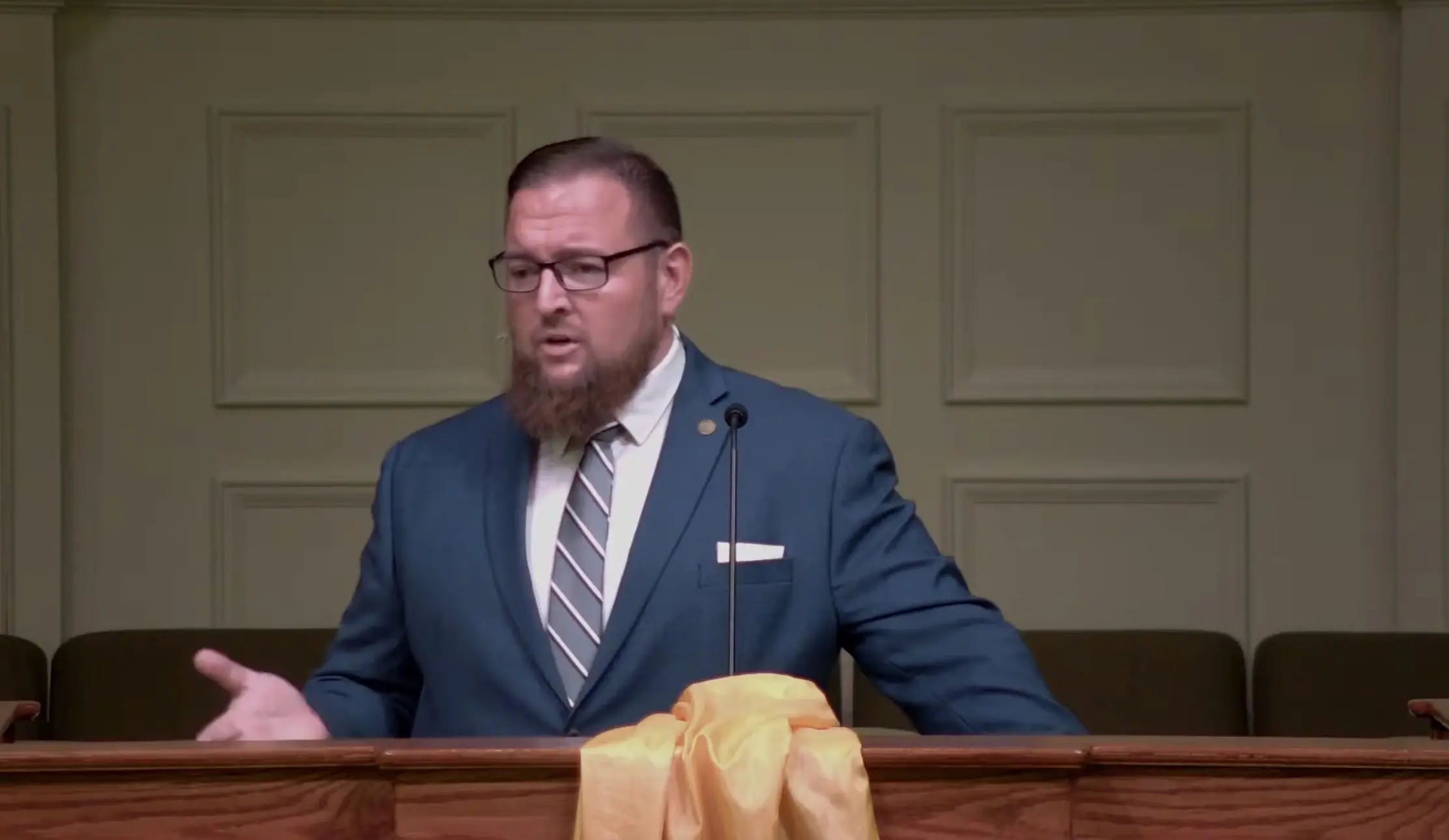

Video
“Family Worship”
Pastor Ryan J. McKeen
03/15/2026
Audio
Transcript
Well, our sermon this evening is really a continuation of the topic we started with last time with everyday worship. And tonight we turn now to family worship. And since we are really just looking at an extension of what we talked about last time, we’re going to go back to the place where we were last time as well. And so turn with me in your Bibles to Deuteronomy chapter six. Again, we come now in this series on worship to the idea of family worship. And no, I don’t mean worship of the family, but worship as a family. And those two ideas are very different and they have very different implications in our daily and family lives.
Again, we looked at everyday worship a couple weeks ago and how true worship is really to be part of our everyday life. And that’s really how the Bible speaks about worship. Really, our lives are to be a living sacrifice, as Romans 12 tells us. And each and every day is to revolve around glorifying God or showing his importance in our life. And that is no different when it comes to our families and our homes.
So tonight, I do want to think a little more about what family worship is, what the Bible says about it, and what it looks like. And that’s how we will approach this topic. We’ll start with the biblical basis for family worship, for worship in the home with the family. And then, secondly, we’ll look at some practical ways that we can do this, what this can look like today.
And one person that has done a lot of work in explaining this and helping people understand this is one of my professors and a regular speaker at conferences these days is Joel Beeke. If you’ve ever heard him speak, you know that he emphasizes family worship. He speaks about it all the time. And that’s one of his main focuses of his ministry. He’s, again, written a lot about the topic, and he’s published a lot of resources to help with these things, help families do this in their homes. And we’ll talk more about resources that are helpful later.
But speaking of his own experience with family worship, and really his opinion on why this isn’t as emphasized today as it used to be in former days, Joel Beeky says this. This is kind of a testimony of his regarding family worship. He says, in many churches and homes, family worship is an optional thing, or at most a superficial exercise, like a brief table grace before meals. And consequently, many children grow up with no experience or impression of the Christian faith and worship as a daily reality.
He continues, when my parents commemorated their 50th anniversary, all five of us children decided to express our thanks to our father and mother for one thing, without consulting each other. Remarkably, all five of us thanked our mother for her prayers, and all five of us thanked our father for his leadership of our Sunday evening family worship.
My brother said, Dad, the oldest memory I have is of tears streaming down your face as you taught us from the Pilgrim’s Progress on Sunday evenings, and how the Holy Spirit leads believers. At the age of three, God used you in family worship to convict me that Christianity was real. No matter how far I went astray in later years, I could never seriously question the reality of Christianity, and I want to thank you for that. And that shows you the impact that even small things, small things in our daily family lives, something like reading books to children at three years old can have on people, the impact that it has on people later in life. As he says, no matter how far I went astray, I could never seriously question the reality of Christianity because he saw it in his father. His father demonstrated those things to him in their everyday life.
And in case you think this idea of family worship is a rare phenomenon with men like Joel Beeke, Beeke gets his conviction about this from his study of church history in the Puritan era especially, from Christians in the past and the way they structured their homes and their churches.
For example, in 1677, there was a church, a Puritan church in Dorchester, Massachusetts, and in their church covenant, It included the commitment to reform our families, engaging ourselves in a conscientious care to set before us and maintain the worship of God in them, and to walk in our houses with perfect hearts in a faithful discharge of all domestic duties, educating, instructing, and charging our children and households to keep the ways of the Lord. It was part of their church covenant In this church back in the 1600s, worship was not simply something that you do in church on Sundays. Throughout the history of the church, and even in scripture, worship was something to be done with families at home as well. This is always the way that God’s people were supposed to function.
So as we begin this evening, we’ll begin with the biblical foundations, where we see family worship in scripture. And we will begin with Moses’ instruction to the people of God as they were to take the promised land. And we’ve spoke about this passage before, but again, think about the context of these people.
They are being delivered out of Egypt. They’re coming from a totally different life, a life in Egypt surrounded by the worship of false gods all around them. They were slaves. Their lives looked a certain way. And so now as God delivers them out of that and plants them in a totally new land, they got to figure life out. They don’t know what life’s going to be like. They don’t have the Egyptian system in place anymore. They have to start all over. They have to start their own civilization, their own country, their own families, and they need to figure this out.
They’ve been wandering in the wilderness, and now they come to the land, and Moses has specific instructions for them on how life should look in God’s nation. in the nation that he called out and delivered and now has placed in the land.” Again, we’ve read this passage before with different emphasis, but tonight I want to read this, Deuteronomy 6, verses 4-9, and look at the emphasis on the family here. And again, Moses provides instructions for heads of households and how they’re to lead their families here. So starting in verse four of chapter six in Deuteronomy, this is the word of the Lord. Hear, O Israel, Yahweh is our God, Yahweh is one. You shall love Yahweh your God with all your heart and with all your soul and with all your might.
These words which I am commanding you today shall be on your heart. And you shall teach them diligently to your sons, and shall speak of them when you sit in your house, and when you walk by the way, and when you lie down, and when you rise up. You shall bind them as a sign on your hand, and they shall be as phylacteries between your eyes. You shall write them on the doorposts of your house and on your gates.” So first you see here, Really, verse four is the confession of Israel. This is what you are supposed to confess. This is the people that you are to be, the people of God, the one God.
And then Moses speaks directly to heads of household. And we know that because the command to teach them diligently to your sons. You know who he’s speaking to here. But that’s not where Moses starts. Moses doesn’t start with the command to teach your children. He starts with, in verse six, these words shall be on your heart.
The men of Israel, the leaders of Homs, were first of all to take their own relationship with God seriously. And this is where family worship needs to begin. that the leaders of homes need to not only care for their own souls and be in relationship with God themselves, but they need to be an example. They lead by example first and foremost.
And that’s what he says. These words shall be on your heart. That’s you. He’s speaking to heads of households, fathers. You are to be an example for your kids. It starts with the head of the house. And then secondly, then he moves on to the family level. So he starts on the personal level. You need to have these words on your heart. And then to the family level.
You shall teach them to your sons. So again, this relationship with God, this being God’s people, what he has called them to, was not an individual thing. It was not just about me and God and we have our thing and we’ll figure it out. It was, you need to teach this to your family. You were to address this to all of those in your household.
Teach them to your sons. You’re to pass this down generation to generation. We need to teach the Bible to children. Teach these things to your sons. And that needs to be something that’s emphasized in a Christian home. This is who God’s people are. You need to teach the Bible to your kids. Don’t think that the hour a week that they get from church is going to be enough. They need to have the Bible as part of their life every day. It needs to be re-emphasized and impressed upon their hearts.
So he goes from the personal level to the family level and then to the community level. He says, you shall bind them. as a sign on your hand and phylacteries between your eyes, and write them on your doorposts of your house and on your gates.” Something to keep in mind here, as Moses speaks about these communities, that even in the culture of the Bible and the Old Testament, days were different then. Life looked different. People lived as family units. People didn’t grow up and leave the house and leave mom and dad behind and go off on their own. Not very often.
Most of the time they were raised as families and clans and they lived in these little villages where everybody they could see in eyesight was part of their family. This part of the family lived over there and that one lived over there. So people lived together in these family units. They lived as whole families, both close family and distant relatives. But again, they lived in these communities. And so family worship was a community thing. This was something that affected their whole village. They were to live as the people of God in front of other people.
And another place that you see Moses instruct the Israelites in this way is in Deuteronomy 11. Keep your finger here in Deuteronomy 6, because we’ll come back to this in a moment. But in Deuteronomy 11, he says something very similar. In chapter 11, verses 18 through 20, this is what Moses says.
He says, you shall therefore place these words of mine on your heart. So again, he starts the same way. Place them on your heart and on your soul, and you shall bind them as a sign on your hand, and they shall be as phylacteries between your eyes. And you shall teach them to your sons, speaking of them when you sit in your house, when you walk along the road, and when you lie down, when you rise up, and you shall write them on the doorposts of your house and on your gates.
So again, very similar teaching, but the point is this is supposed to be part of your life. This is supposed to affect all that you do as a household. It’s the same order we saw in chapter six. Starts with you, heads of household. It starts with you, then it goes to the family, and then the community around you.
And again, you should be teaching these words, the words of Moses, God’s word given to God’s people. So God’s word needs to be taught in the home. Again, it’s not just something that happens at church. God’s word should be taught in our homes. Everywhere we go and everything we do should revolve around being God’s people, having God’s word be part of our life.
This is worshiping God in the context of our families. Moses isn’t even speaking about their worship services yet. This isn’t talking about their ritual worship or their sacrifices or anything like that. This is how they were to live as families at home every day. This was what their life was to look like.
And so again, back in Deuteronomy chapter six, Moses gives a practical example. Moses is a good preacher, he gives illustration, and he gives them an example of what this looks like. So if you’re in Deuteronomy 6, again, look down a little ways to verse 20. After he gives the instruction of, you need to take this seriously, teach them to your sons, and then teach them to the community, have this every part of your life, down to verse 20, Moses says, as he gives an example here, then when your sons ask you, in times to come, saying, what do the testimonies and the statutes and the judgments mean which Yahweh our God commanded you?
Then you shall say to your son, we were slaves to Pharaoh in Egypt and Yahweh brought us from Egypt with a strong hand. Moreover, Yahweh showed great and calamitous signs and wonders before our eyes against Egypt, Pharaoh, and all his household. But he brought us out from there in order to bring us in, to give us the land which he had sworn to our fathers. So Yahweh commanded us to do all these statutes, to fear Yahweh our God. for our good all our days and for our survival as it is today. And it will be righteousness for us if we are careful to do all this commandment before Yahweh our God, just as He commanded us.
This is a question and answer time with children. This isn’t a seminary setting. This isn’t a biblical education setting. This is sitting around the dinner table and the son asks the question, why do we do these things? This is a family in-home setting.
This is the typical why question the children ask. when they have a million why questions. Why do we do this? Why? Why? That’s what kids do. They ask the why questions. I remember as a young kid having a million why questions for my dad as we worked around the farm and did all sorts of different things. I was a curious kid. I had a lot of questions. And I guess that really never changed. But kids ask the why questions.
And the Bible shows us that we should be directing these conversations around the word of God. Your kids are going to be curious. Help them to be curious about the things of God. And we do this by keeping the things of God before them, talking about them, reading them in our homes. We can see various other examples of family worship throughout the Old Testament.
Think, for example, One of the main worship settings for the people of Israel throughout the year was the Passover, right? The Passover meal that was instituted by God to teach these people about their salvation. One of the most important things Israel was to do as part of their worship, it was central to their worship. And who was involved with that? Who was involved in this worship ritual every year? Was it just the priests? Was it just the heads of households? No, every family, every household was to do this.
In Exodus 12, it gives the full explanation and description of the Passover meal that they were to do. And it starts this way in Exodus 12, starting in verse 1. Now, Yahweh said to Moses and Aaron in the land of Egypt, this month shall be the beginning of months for you. It is to be the first month of the year for you. Speak to all the congregation of Israel saying, On the 10th of this month, they are each one to take a lamb for themselves.
Again, this is everybody. This isn’t just, oh, we’re going to go to this one worship service and we’re going to do this one meal and everybody gets to watch. Each household takes a lamb for themselves according to their father’s households, a lamb for each household. And it goes on to talk about how if the household’s too small for a lamb, then share it with the neighbors. But it’s supposed to be for each house and they were each supposed to be participating in this worship we’re supposed to teach them all who God is and What he had done for them and while we’re no longer under these Old Testament worship rituals We ought to be teaching our families What Jesus Christ has done for us as the Passover lamb? and later in the Old Testament in the book of Joshua. If you want to turn there to Joshua 24, the very next book after Deuteronomy. But Joshua 24, after they have come in and conquered the land, similar to Moses, as Joshua is nearing the end of his leading Israel.
He challenges Israel to continue to follow the Lord who delivered them. The Lord who delivered them out of Egypt, led them through the wilderness, and now has provided them this land. And this is his challenge to them, and not only to follow them, but to commit their families to follow him.
In Joshua 24, starting in verse 14, it says, so now, so he recalls all the things that God has done for them, and then he says, so now, fear Yahweh. and serve him in integrity and truth, and put away the gods which your fathers served beyond the river and in Egypt, and serve Yahweh. If it is evil in your sight to serve Yahweh, choose for yourselves today whom you will serve, whether the gods which your fathers served, which were beyond the river, or the gods of the Amorites in whose land you are living. But as for me and my house, we will serve Yahweh. as for me and my house. Joshua was declaring who his household would worship because he led his household in worship. He took charge, took responsibility of who my house will worship, and I’m going to lead them in this, and he’s challenging all the rest of the households to do the same thing. But this, again, wasn’t just an Old Testament thing. As we come to the New Testament and the arrival of Jesus on the scene, we also see whole families worshiping together. There’s a few different examples of this.
In John 4, which we’ve covered a few months ago in the Sunday mornings, we have the healing of the royal official’s son, as you remember. As Jesus tells the man to go home, that your son will be healed. The father, in verse 53 of chapter four, the father, he asks, at what time did this happen? In verse 53 he says, so the father knew that it was at that hour which Jesus said to him, your son lives.
And here’s the point I want to emphasize. It says, and he believed and his whole household. His whole household believed. And the same is true with several different figures we see in the New Testament, in Cornelius, in Acts chapter 10, as Peter comes and shares the gospel with him and his family. We read in Acts 10, starting in verse one, first it says, now there was a man at Caesarea named Cornelius, a centurion, what was called the Italian cohort, a devout man and one who feared God with all his household. Again, he leads them in worship. He didn’t have his own individual personal worship and his household did what they wanted. He feared God with all of his household.
And later in chapter 10, as Peter comes and tells them about Jesus and preaches the gospel to them, they believe and they receive the Holy Spirit. So he was a God fearer, but once he heard about Jesus and they all believed, the whole household was baptized. After they believed, of course. But they all were on the same page. They were all worshiping together. They worshiped as a household.
In other households, we see the same thing. For example, Lydia in Acts 16, in Thyatira there. She and her household. She offered her household as a place for the church. You see Crispus of Corinth in Acts 18. The Philippian jailer in Acts 16. All of these are examples where the household worships together. And at the beginning of the church, whole household conversion was a regular thing. And families worshiped together in their homes before they ever had church buildings. But another clear example of family worship, and what I want to focus in on a little bit here, is the example of Timothy. I think Timothy’s a great example of this.
So if you want to turn with me to 2 Timothy. 2 Timothy, and we’ll start in chapter one. as you know, was Paul’s young pastor protege, one of the ones that Paul was raising up to leave behind in a church and to install as a pastor to lead that church. And young Timothy was a product of intentional instruction and family worship in the household he grew up in, in 2 Timothy chapter one. Verse five, Paul says this about Timothy as he’s recalling the blessing that Timothy is to him.
And he says in verse five, being reminded of the unhypocritical faith within you, which first dwelt in your grandmother Lois and your mother Eunice, and I am convinced that it is in you as well. You see, Timothy had an example. He had an example to follow in his mother and his grandmother of faithful women of God. And Paul said, and I’m convinced because I know your mother and your grandmother and the way that they lived, and now what I see in you, that you have that same faith. And then flip over a couple of pages to chapter three where Paul expounds a little more on Timothy and his upbringing.
Second Timothy chapter three, verse 16 of course is one of our favorite passages on the sufficiency of scripture. But back up a little bit to verse 14. As Paul has warned Timothy of the difficult times that are coming, in verse 14 he says, but you. Verse 13 he talks about the evil men and the imposters and all the bad things that’ll happen, but he says, but you.
Continue in the things you learned and became convinced of, knowing from whom you learned them, who Paul already mentioned. and that from childhood you have known the sacred writings which are able to make you wise unto salvation through faith which is in Jesus Christ. Timothy learned and became convinced of the things he believed as a child and that equipped him for later on in life when Paul warns things are going to get worse and things are gonna be bad.
But you already have what you need. You have learned and become convinced of the things of Scripture, as he goes on to explain what those things are in the next few verses. But Timothy didn’t become a faithful Christian when he met Paul. He didn’t become a faithful God-fearer when Paul came on the scene. He learned those things as a child, and they greatly benefited him later in life. I think this is instructive for us.
You want your child or your children to grow up to be faithful Timothys? Teach and convince them of the things of God when they’re children, when they’re young and impressionable. Teach them the Bible. Yes, indoctrinate them. That is a good word. Whether or not you have heard that term, indoctrination is what we ought to be doing. So you may be thinking, okay, I see the biblical pattern and the importance of this. We see this from the beginning pages of scripture here to the last pages. So we see that we need to do this. And again, I know many of the families of this church do this.
You already do this. So this isn’t meant to be a, you’re not doing this well. This is meant to be an encouragement. Continue in these things. Continue to do this. See the importance of what you are doing. and continue to grow in these things. And as we see the importance of it, the next question is, okay, but how do we do it? What does this look like today? We do want to raise Timothys. We want them to be instructed and convinced of the things of the Lord, the things of scripture, but how? What does this look like?
And with the remaining time that we have, I’d like to look at some practical options for how to do this. And I mentioned Joel Beeky earlier and all the helpful resources that he has provided. And he has several tips on how to do this well and what this can look like. So a lot of what follows here is borrowed from his work.
But again, there is no family worship rule book in scripture. There is no, you must do this and must not do that. So this looks different for different families. But we do see the principle in Scripture that we must be doing something to train up children in the training and instruction of the Lord. That’s what we ought to be aiming at.
That’s what Scripture tells us. Now, the specifics of what that looks like can look different for different people, but according to the Bible, according to Scripture, God should be served in worship in several ways that apply to our families. First of all, is instruction in God’s Word. Instruction in God’s Word.
This is what we see with Timothy. It says, continue in the things you have learned and become convinced of, knowing from whom you learned and that from childhood you have known the sacred writings, which are able to make you wise unto salvation. In this context, in the context of Paul to Timothy, the sacred writings were the Old Testament. They were what we were just looking at.
And God ought to be worshiped in our homes through his word, by reading and instructing from his word and doing it on a daily basis, making this a regular thing. And there’s a lot of different ways that this can happen from just daily reading to questions and answers and instruction, having an instructive time where you ask the questions and allow children to give their answers.
But parents and children ought to be interacting daily with scripture. And not just parents and children. Husbands and wives, too. Husbands ought to be leading their wives in their daily Bible reading. So whether you read the Bible together or whether you read it separately, interact with each other about it. Talk to each other about what you’re reading. And husbands ought to lead in this. But again, this is family worship concerning the word of God, concerning the scriptures.
Again, this would be following what we read in Deuteronomy 6, both in verses 6 and 7, and then in the example we saw of verses 20 to 25, the question and answer time. Why do we have to do these things? Why did God tell us to do this? And then Moses gives the example of giving an answer of what God has done and explaining from scripture the things that God tells us and what he has done.
Again, according to Joel Beeke, he gives some examples. He says, in an orderly home, these activities are done at specific times of the day. So that can look different for different people. And they offer opportunities for regular, consistent, and daily times of instruction. We know that repetition is key in learning. So doing these things on a regular basis.
And again, thinking about that example in Deuteronomy, Moses isn’t just… talking about a passing conversation. This is a dedicated time of questions and answers and instruction that the parents have with children. So again, this is an important thing we see emphasized here in the pages of Scripture. And Moses says that words from God should be on a father’s heart first. So that’s something else to remember as we come to the reading of Scripture in the home.
Men, you ought to be leading in this. This ought to be one of your priorities, your own personal time with God, so that these things are first on your heart and then taught to your children. A similar text in the New Testament that reflects these things is in Ephesians chapter six. Ephesians chapter six, verse four.
It says, fathers, do not provoke your children to anger, but bring them up in the discipline and instruction of the Lord. Bring them up in the discipline and instruction of the Lord. Bring them up knowing scripture. Bring them up teaching them the things of God.
And you might be thinking, well, as a father, as the head of the household, as the provider, sometimes I work at times when this can be done. And I’m not in the home when the children are awake and able to learn these things. So how does that work? Well, there are several times that this can be done, so there’s no specific prescribed time, but also when fathers can’t do this, mothers can. The principle is that fathers ought to be making sure this is happening, that fathers ought to be leading in this and they’re responsible to make sure this instruction is happening. It doesn’t mean they have to be the one to do it every day.
And again, for example, Timothy, who did Timothy learn from? His mother and his grandmother. That’s who Paul mentioned. So the instruction of a God-fearing mother or even grandmother is an example we’re given in scripture. So again, it’s the daily Bible instruction that’s important, not necessarily how it looks every day. Sometimes it looks different.
And again, if you wanna know more about daily Bible teaching, there are a lot of good resources about that. We’ll end with some discussion, but one I wanna highlight, there’s a book called Expository Parenting. It’s a book that talks through the importance of teaching your children the Word of God and different ways that that can happen. They also have a website that has many good articles. It’s got the same name, Expository Parenting, but that’s a good resource for parents and families.
Instruction from the Bible is number one. That’s one of the best ways that we can raise children and that we can lead households in the discipline and instruction of the Lord. So number one is Bible instruction. Secondly, prayer. Leading family in prayer. There’s a passage in Jeremiah.
It’s interesting, as God is speaking about the wrath that he will pour out, the judgment that will come upon the nations, and this is what it says in Jeremiah 10, 25. It says, pour out your wrath on the nations that do not know you, and on the families that do not call on your name. This is what separates the people of God from those who aren’t his people. Do they call on his name? The families that do not call on your name. All families ought to be calling on the name of God. They ought to be praying together.
Families should pray together as much as we can. Psalm 128 verse three, your wife shall be like a fruitful vine in the innermost parts of your house, and your children like olive plants all around your table. So the picture here in the Psalms is a family gathered around the table. Families ought to eat and drink their meals together. So pray before meals. That’s a great time to pray together. Pray before bedtime. And to do that in a Christian way, Paul again instructs Timothy in 1 Timothy chapter four, starting in verse four.
For everything created by God is good, and nothing is to be rejected if it is received with thanksgiving, for it is sanctified by the word of God and prayer. If you’re going to eat and drink to the glory of God, like scripture tells us to, and the food we’re about to eat is to be set apart for that purpose, we are to pray for it. It is sanctified by prayer. It is set apart in our minds as glorifying God, as given to God’s glory. Now, praying for our food doesn’t change the food at all. It doesn’t automatically make it healthy for us or make it more holy as we go to eat it.
But that time that we spend to pray and thank God for it, it sets it apart in our mind. That’s that sanctifying it in your minds for the glory of God. It’s reminding yourself where it came from, reminding yourself who provided it for you. And it’s that daily practice, that regular practice of sanctifying, setting things apart in our minds for the glory of God.
And again, the reason we ought to pray at meals is because we eat meals regularly. It’s not something we often forget to do. So as we pray for every meal, it’s making us pray regularly. It’s a good habit to be in. It regularly reminds us to talk to God, to thank Him for who He is and what He’s provided for us, to remind us of who God is and who we are in light of Him, and to teach your children to do the same thing. to give that daily practice of reminding ourselves who God is and teaching that to your family as they are young and impressionable and growing in these things. Again, listen again to Joel Beeky’s reasons why families ought to pray together. This is what he says. He says, don’t families commit daily sins?
Shouldn’t they daily seek forgiveness? Does not God bless them in many ways every day? Should not these blessings be acknowledged with daily thanksgiving? Shouldn’t they daily acknowledge God in all their ways, begging Him to direct their paths? Shouldn’t they daily commend themselves to His care and protection?
Yes, all of these things are true. We need God each and every day. We need to be praying to God. And again, our Christian faith is not just something private. It’s not something between me and God and nobody else should know about it. Our daily prayer and prayer with our family is a good way to demonstrate our faith to those around us.
And again, at very least, we should be doing things like praying for forgiveness. We need forgiveness every day. It shouldn’t be surprising to your children that you need forgiveness too. So pray for those things in front of them. and thanking God for His blessings every day, thanking Him for His guidance and protection. And again, we should be doing this together as households, as families.
And this was an interesting quote and one I thought was pretty meaningful. Thomas Brooks, the great Puritans, said this. He said, a family without prayer is like a house without a roof, open and exposed to all the storms of heaven. Prayer is important. Prayer is an important part. It should be part of our daily lives, and that’s an important part of family worship. The third thing is daily singing to the glory of God. Now, I am not personally musically inclined, and I wasn’t raised in a family that sang together much. But you can’t deny what scripture says about singing, about singing to the glory of God.
Psalm 118, verse 15. I like this verse, it resonates with me. The sound of joyful shouting and salvation is in the tents of the righteous. The right hand of Yahweh does valiantly. This is a reference to singing, and if you’re like me, your singing might sound a lot like shouting sometimes. But it’s coming from the tents of the righteous. And the psalmist there says this sound is in the tents of the righteous, not it ought to be. This is what the people of God do.
They sing. Joyful singing comes from the tents of the righteous. In Psalm 66, verses one and two, make a loud shout to God all the earth. Sing praise for the glory of his name. Establish his praise as glorious. God is to be worshiped and in singing. God is glorified when families are edified by this singing.
And again, if you’re like me and are not musically talented, inclined, or capable, and I know you know this is true. because there have been times when my microphone has been left on during the live stream and singing, and very quickly I get text messages telling them to turn the mic off.
So I know that you know. But if you’re like me and are not musically gifted, you could say, you can sing along with good Christian songs on the radio or on Spotify or however you listen to music. Sing along with other people that know how to sing. Do that with your family. And again, music is a wonderful teaching tool. You learn songs and if you’re singing good words and songs that reinforce the truths of scripture, it’s a great way to teach families and children the truths of God’s word. And if you’re, again, like me, just turn it up really loud and drown yourself out. It really helps.
So again, We need to be worshiping as families, not just in church on Sunday, not just the hour we spend together in the house of God once a week. We need to worship every day. We need to worship with families. And this is part of raising children in the discipline and instruction of the Lord. And God requires that we worship him, not just privately as individuals, but together as a church body and community and as families. Jesus is worthy of it. Yes, sometimes it’s hard and it’s difficult to make it work every day and sometimes we miss and don’t do it as regularly as we know that we should, but Jesus is worth our efforts in it. He is worth pursuing, worshiping him as a family. And God’s word instructs us in that. Our families owe their allegiance to God. As for me and my house, we will worship the Lord.
And so, parents, God has placed you in a specific place for a reason, a place of authority in your children’s lives. And it’s not just to be their friend. It’s to be their teacher and their leader and their instructor. And your roles in your homes are so important. And that’s why I wanted to take a specific sermon to emphasize this. And this isn’t to try to berate you for not doing it well. It’s to encourage you. This is important.
And I want to help and encourage this as much as we can. And again, if you’re thinking, well, this sounds great, but I don’t know how to do this. I don’t know what this looks like. I don’t know how I would even do this.” Well, there are a lot of really great resources today that help in these things.
There’s been a lot of things developed for this very reason, for worshiping together as a family in the home. Again, I’ve mentioned his name a lot, but Joel Beeke has good resources on this. He has written a book called The Family Worship Bible Guide. And it is meant to be used by family.
He’s done the work for you. He has laid out scripture passages that you can read every day and given questions that can help you help your children understand what it’s about. It covers all 1189 chapters of the Bible. And he’s done a lot of work putting this all together with the intent of providing parents a resource that they can use to lead their families in these things.
I mentioned earlier the book Expository Parenting, which is more speaking about the concept of family worship, but that’s a great resource as well. And then this one, which I had and brought it with me, is from the G3 Ministries resource. It’s called Tune My Heart. and it goes through all the narratives of scripture and it has five days a week reading plans.
It’s got study notes and questions, and it’s got a catechism in there that you can ask and answer questions with your children and help learn that way. It’s got Bible memory verses to help learn scripture, and it’s even got hymns in there that you can sing together.
Again, if you don’t know what this looks like, there’s a lot of ways it can look, and there’s a lot of resources that help shape this in your home. Again, you’re not on your own in this. You have the church that can help provide and help teach you how to do this. But again, there’s also really good resources that help tremendously. And you can come talk to me more about that if you want to know more about those things.
But tonight, in closing, worship is not simply something we do here. Worship is not just something we do when we come to this building once a week and worship God. Worship should be done in our homes and in our families as well. We are instructed to raise our children a specific way in the discipline and instruction of the Lord. So we need to teach children to know him. Heads of household, men, we need to lead our families in this. We need to lead our wives in this. We need to teach children to know that Jesus came and He lived and He died for sinners, and that they need to believe in Him as their Savior, and we need to train families to live each and every day to worship Him.
Let’s stand and close in a word of prayer this evening. our God in heaven, we thank you for all the practical instruction that your word gives us. And as we see, even tonight, this importance that your word places on the family, the emphasis that it has on worshiping you in our homes. And we just, I pray tonight that as we go from here, we would remember these things and that we would, each one of us, would go back to our own homes and whatever our family looks like, whatever our situation looks like, that we would find ways to prioritize worshiping you each and every day through reading your word, through our prayers, even through singing. Lord, we thank you for the way that you’ve revealed yourself to us. We thank you for the way that you have saved us. And Lord, we pray that you would help us learn how to worship you each and every day. We thank you for who you are, for what you’ve done for us in our salvation. We pray all of this in Jesus’ name, amen.