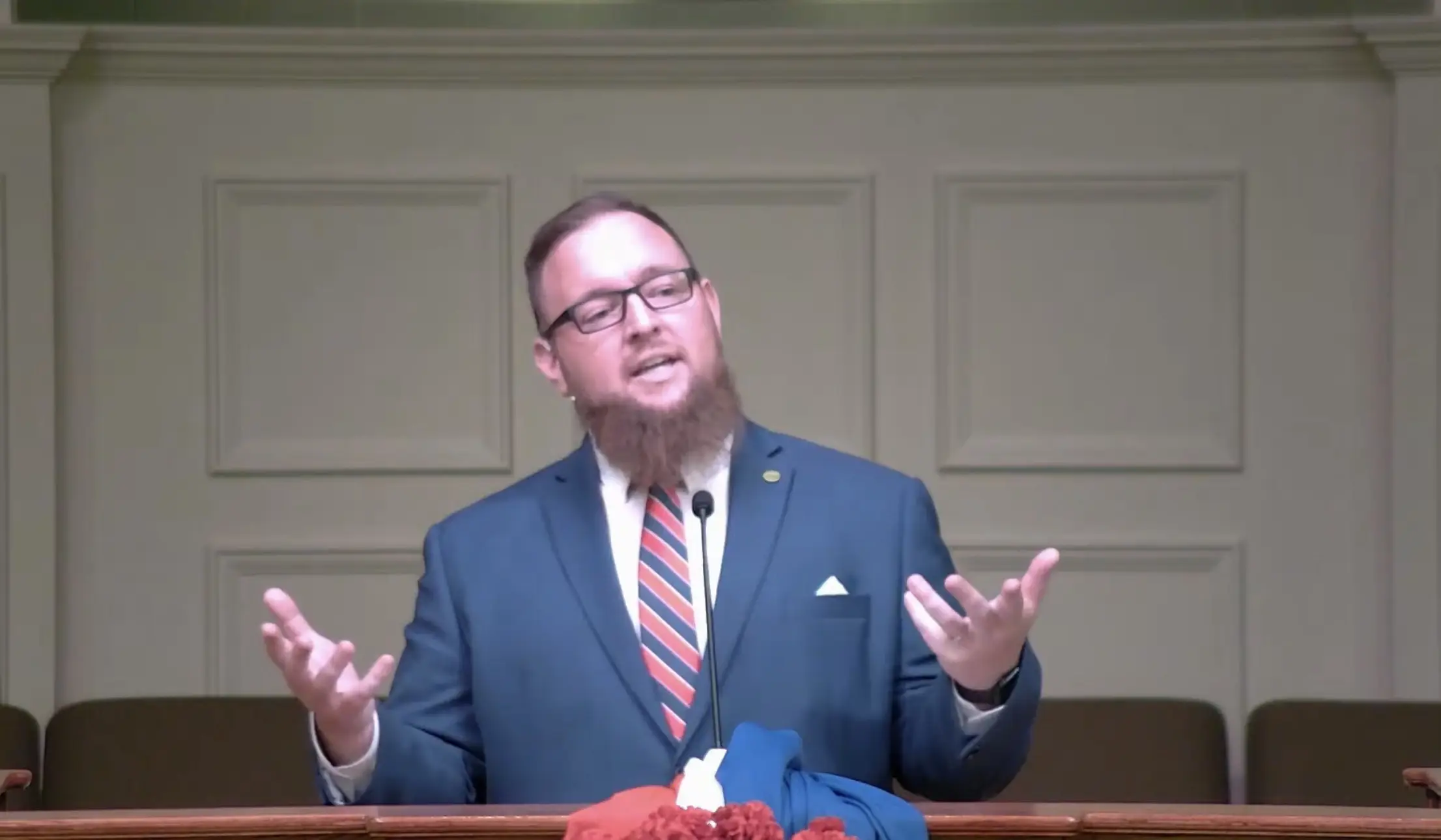

Video
“Giving as Worship”
Pastor Ryan J. McKeen
06/14/2026
Audio
Transcript
Well, turn with me in your Bibles to Genesis chapter 14. Genesis chapter 14, that is where we will begin this evening here in a few moments. We are continuing our series on worship, and we have been examining the practices that are involved in our corporate worship services.
We’ve talked about the things commanded in Scripture, things like baptism in the Lord’s The preaching and the reading of God’s word. And last time, a few weeks ago, we talked about prayer in our worship. And tonight I want to talk about another practice that we incorporate in our worship services as part of how we worship God. And it is another thing that is commanded of us in scripture. It is something we should be doing according to what the Bible says.
And the subject is giving. See in your bulletins there, the title of this sermon is Giving as Worship, and I’m beginning to wonder if people looked ahead to see what the context of the message was gonna be, because our attendance here tonight is less than half of what it usually is. But I don’t think that’s the reason why. I think just everyone took vacation this week. And I know that some preachers get very nervous in talking about giving, but we really shouldn’t.
This is something God’s word speaks about and so should we. And so tonight I want to talk about what God’s word says. And so if my talking about this subject makes you upset, please only be upset with me if I am not in line with what scripture says. But if what I do say does come from God’s word, you need to take that up with him.
And this is not meant to plead with you to give more or anything like that. We have a very generous church, and I’m very thankful for that. Not because of the money, but because it shows where our hearts are, and that’s a good thing. But this is meant to help us think correctly about our giving, to think correctly about what we do when we give, especially as it relates to giving as worship. So what I want to do tonight is talk about giving, and we will start first with what giving is not. What our giving today in church, in our worship is not, and then we’ll talk about what giving is.
And giving and offerings have always been a part of the worship of God. It is giving back to Him from what He has already given to us. It is recognizing who all things truly belong to. And this was part of the sacrificial system for Israel in their worship, and it has always been a worship practice of God’s people because our money reveals our priorities.
If you want to know what you value most, you look at your spending habits. And that can generally tell you the things that you value. Not that giving must be your largest expense or anything like that, but it ought to be a regular one. It ought to be something that is seen in your regular finances. And regular giving that shapes the rest of your budget, the rest of your finances in life, reveals that you value honoring God with the wealth that he has given you. It shows that you acknowledge his importance and worth with your finances. And that’s what worship truly is, is acknowledging the value and worth and the importance of God.
And when it comes to our giving in church, Many churches have traditionally used a certain term to refer to it, and that term is tithe, or tithing. I heard that growing up, and many churches use that to refer to our giving today, and it’s a term that is found in the Bible. But is our giving today what the Bible calls tithing? Is what we do today the same as biblical tithing? Is it even related to tithing? Well, that’s what I want to look at first tonight as we consider our giving as worship. And I do want to give credit where it is due, some helpful resources that have helped shape my thinking on some of these things.
There’s a ministry that’s actually called Expository Parenting. It’s an excellent ministry. They have a lot of great resources on parenting and many other topics. They publish some books and they have a website and a blog that’s been very helpful. In fact, we actually have a link to their website on our website, because I think it’s a very helpful resource for us. But a couple of years ago, Josh, one of the guys that runs that ministry, wrote a blog article about tithing, and it was very good and very helpful in helping me rethink and consider not only what we do, but even the language that we use when we think about our giving. And that also helps recommend some other resources there. So just giving credit where it’s due as we approach this topic.
But what is biblical tithing and is that what we do? First of all, the word tithe means 10%. That’s what that word means. And so typically the belief is, the general church understanding is, that according to the Bible, we should all be giving 10% of our income to the church. That’s the biblical standard, and that’s what Christians ought to do, is give 10%. So let’s talk about what the Bible says about tithing. And the first place we see tithing mentioned, or tithe mentioned, is here where I told you to turn in Genesis 14. So if you’re not there yet, turn there to Genesis 14 with me.
And those who typically are more insistent on the principle of tithing, they use passages like this a lot. And they start here because this is before the Mosaic law. And so the argument that while tithing was a Mosaic law thing, that isn’t true either, because there was a tithe before the law. And the argument goes that because tithing occurred before the law of Moses, it’s therefore a universal principle that applies even after the law is fulfilled. So whether you’re an old covenant saint or a new covenant Christian, tithing applies. What is tithing? What was tithing in Genesis? And what was tithing in the law?
And we’ll get to the law later. But here in Genesis, we see the very first instance of tithing. And we will see the very first reason why giving, our giving today, Christian giving, is not tithing. The first reason that your regular giving to your church is not a tithe, is based on the frequency we see when it comes to tithing. The first use of this word is here in Genesis 14, starting in verse 18 through verse 20. And this is what it says, striking of Melchizedek and Abraham. Melchizedek, the king of Salem, brought out bread and wine.
Now he was a priest of God most high. Then he blessed him and said, blessed be Abram of God most high, possessor of heaven and earth, and blessed be God most high who has delivered your enemies into your hand. Then he gave him a tenth, or a tithe, of all.” So here we see that Abraham, or Abram, was victorious in his battle and after conquering the five kings in the area, Abraham got pretty wealthy. He gathered quite a bit of wealth from defeating these kings and these armies and really these nations. So while returning home, he meets this priest, Melchizedek, the priest of the Most High God. And he met him and blessed the one true God who gave Abraham the victory.
He’s recognizing from whom all things come. So there are some good principles we see here. And that’s when Abram gives him a tenth of all. Now, one thing that’s important to notice about this occurrence of a tithe is that this was a one-time thing. This was a once-in-a-lifetime thing.
We don’t ever see Abraham ever giving tithe ever again. And Melchizedek’s involvement with Abraham’s life ends after this. We never hear of Melchizedek until the New Testament when they’re talking about this, this appearance of Melchizedek. And so Abraham did not give a weekly or monthly or yearly 10% contribution.
This was a one-time event that occurred after he defeated these kings. The idea of a 10% annual income given by Christians as a tithe, if that’s what we ought to do, really doesn’t have a lot to do with this occurrence of a tithe, because this was a one-time event.
Then we see another occurrence in Genesis 28. So turn over to Genesis 28 with me. Here we see Jacob. Jacob, Abraham’s grandson, has a dream in Genesis 28. And we don’t have time to talk about his dream here, but following his dream, God reiterates to Jacob the promises given to Abraham and Isaac, the Abrahamic covenant. And Yahweh promised that he would be with Jacob and protect him. So when Jacob woke up, he praised God and he named the place Bethel, which means house of God. And Jacob made a vow that if God would give him the material goods that he needed, he would return a tenth of all to him.
That’s what it says in verse 22 there of Genesis 28, the last verse of the chapter. It says, now this stone, which I have set up as a pillar, will be God’s house. And of all that you give me, I will surely give you a tenth. But again, this is a one-time occurrence. Jacob gave a 10th because he received revelation from God about his redemptive plan, his promise to bring about salvation and redemption to his people. And that dream has never happened to any of us. So this is a different context. And this 10th given by Jacob was, again, a one-time experience that happened because of revelation to him.
But what about the law? These are pre-law tithe occurrences. What happens in the law? What is it that Moses commanded, that God commanded through Moses? Well, in the law, the tithe was a regular collected amount from the average Israelite. So now we are talking about regular giving. But what was the tithe in the law? Well, really, there’s three passages that describe in the law, the tithing principles that Israel was supposed to follow.
The first one is in Leviticus 27. So if you want to turn over there, in Leviticus 27, we see Moses giving instructions on the tithe. And in chapter 27, verse 30, this is what Moses has to say to Israel. After explaining what the tithe is, he says then in verse 30, thus, all the tithe of the land, of the seed of the land or of the fruit of the tree belongs to Yahweh. It is holy to Yahweh. So according to the law here, and it’s explained before that, but in summary, verse 30 there, A 10th of each Israelite’s harvest, a 10th of their produce, a 10th of what God had given them belonged to Yahweh.
So you see there the 10th, and that was every year. A 10th of their yearly income belonged to God because God was the one that gave them all things, which meant that this was to be given in support of the priests. That’s what that passage there says.
The priests, the Levites, who ministered on God’s behalf, this was how they made their living. Because the priests did not have their own land and their own occupations. Their job was to serve in the temple. So they didn’t have a way of making money, so this is how that tribe, the Levites, had an income. In his book called Giving God’s Way, John MacArthur speaks about this tithe, and this is what he explains. He says, this tithe was given to the tribe of priests who support them because their religious responsibilities were a full-time ministry. They didn’t have the opportunity to earn their own living. They were, in a sense, the government of their land. Israel wasn’t a democracy, it was a theocracy. Who was the ruler of Israel? God. Who were his vice regents or his servants? The priests.
So when you come right down to it, the Levi’s tithe paid the salaries of those who ran the country. So that was the tithe in Israel. It was 10%. That was the first instance of a tithe in the law. But wait, there’s more. There’s another tithe we see. Turn to Deuteronomy chapter 12. In Deuteronomy chapter 12, we read of another separate tithe. Deuteronomy 12, starting in verse 10.
It says this, now you will cross the Jordan and live in the land which Yahweh your God is giving you to inherit. And he will give you rest from all your enemies around you so that you live in security. Then it will be that the place in which Yahweh your God will choose for his name to dwell, there you shall bring all that I am commanding you, your burnt offerings, your sacrifices, your tithes. There’s multiple tithes here, and the contribution of your land, and your choice of votive offerings, which you will vow to Yahweh.
And if you look down to verse 17, it talks about this other tithe there to bring in. It says, you are not allowed to eat within your gates the tithe of your grain or your new wine. So this is another tithe. Because the first tithe was of their produce, of their trees, of the things that they had harvested. This is of their grain, and their new wine, and their oil, or the firstborn of their flock, or any of your votive offerings which you vow, or freewill offerings, which means the over and above what you were required to tithe. or the contribution of your hand.
It goes on to describe the way that this tithe was to be used, and it was to be used in the community, in the families, as they came together and had festivals. As they were commanded to come in, observe these feasts, the second tithe was known as the festival tithe. Every year, another 10th, in addition to the first 10th, was to be given to cover the annual festivals in the temple. Again, John MacArthur in that same book describes this tithe this way. He says this is another tithe, another 10%.
This 10% was to be taken to Jerusalem and to be eaten by families and friends and servants and priests in the sanctuary. This tithe would simulate devotion to the Lord and promote unity in the family. It was a kind of like a national potluck. It made everybody share. This tithe called the festival tithe perpetuated the religious and social life of the nation. So the Levites’ tithe supported the government people. This one helped the religious, social, and cultural community by increasing love for God, by teaching individuals to share with others. It taught community and social involvement.
So that’s the second tithe. So now we’re at 20%. 20% of the annual income, the annual harvest, what they made their wealth off, 20% of that now has to be given by an Israelite as tithe. And if you thought you’re done, They’re not. If you turn over a couple pages to Deuteronomy 14, Deuteronomy 14, the last two verses of that chapter, verses 28 and 29, a third tithe was known as the poor tithe. It says, starting in verse 28, at the end of every third year, you shall bring out all the tithe of your produce. Every time you see that word, that’s another 10%. So at the end of every third year, another tithe of your produce in that year, and you shall deposit it within your gates.
And the Levite, because he has no portion or inheritance among you, and the sojourner, and the orphan, and the widow who are within your gates, shall come and eat and be satisfied, in order that Yahweh your God may bless you in all the work of your hand which you do.” So every third year, another tenth, on top of the first and second tenth, was to be given to support the poor among the nation. So this was somewhat of a welfare program for the nation of Israel. It cared for the poor and the widows and the people who didn’t have anything to eat. So now if you want to have a modern day equivalent in our giving, this is somewhat like our benevolence offering that we take in at the end of every service on the first Sunday of the month, and we use that to help the needs that we can. Although we use that for more than just those who are hungry and need food, there’s other needs that we use that to help provide for.
But this is a third tithe. So when you add up the first 10%, the Israelites had to give every year, and the second 10% they had to give every year, and the third 10% that they had to give every three years, this averages out to 23.3% of their annual income was given as a tithe. That was the tithe for an Israelite. or 20% for two years and 30% the third year if you didn’t budget right. So if you want to use the biblical tithe principle to say that, well, 10% is a good biblical starting point for a Christian, really you’re about 13.3% short because the biblical tithe was 23.3%. So does this tithe principle equate to your annual giving or your regular giving?
No, not really. Well, we use that number, which is nothing wrong with a number, but we need to understand the principle of what a tithe was. And a closer look at these passages show that 10% falls quite a bit short of what the biblical Mosaic law tithe was. And there’s another aspect of the Old Testament tithe that we need to consider before we compare it to our tithing. And we sort of mentioned it a little bit.
But that is the motivation for this tithe. Tithing, based on the Mosaic law, was exactly that. It was the law. It was required. When Moses instituted the tithing system, this was not a suggested offering. This was not a good faith donation or a free will offering. They had those too, but this was required. 23.3% was the minimum. And Israelites could not decide whether or not they wanted to participate.
Moses said, you shall over and over and over when speaking of these tithes, this is what they must do. This was required. So in reality, the tithe was a tax. The tithe was a tax for the Israelite government so that the Israelite nation could run smoothly.
Israelites, if they wanted to give more over and above that, they were more than willing to do that. And we see instances of that, and they were called free will offerings. We see in Leviticus 23, verse 38, Moses speaking of those Sabbaths of Yahweh and besides your gifts and besides your votive and free will offerings that you give to Yahweh. This is talking about the over and above things, the things that they went beyond what was required.
But the tithe, the tithe was required. Alistair Begg, another pastor, explains the tithe like this. He says, there was a tithe for the Levites, which was the government. There was a tithe for the national feast, which was the community. And there was a tithe for the helping the poor, which was welfare.
And when you put it all together, it amounts to 23% of the people’s income. Israel was a theocracy or they were ruled by God. And in order for the structure of the nature to function, they needed these taxes. And these tithes were the taxes that the nation might function effectively. They were not free will offerings. So a tithe, the motivation behind a tithe was not Generous giving. It was tax.
It was a required tax that the Israelites were required to pay. And this is a very different idea than New Testament giving. This is a very different idea than what is spoken of in the New Testament. And this is why, this helps explain to us why God in Malachi chapter three, when he is condemning the nation of Israel for their sin, He says in Malachi chapter 3 verse 8, one of the things they were doing wrong, he says, will a man rob God? Yet you are robbing me. And you say, how have we robbed you?
And he says, in tithes and contributions. They were robbing him in their tithes because they weren’t giving what they were required to give. This was required under the law. And so, when an Israelite did not pay his full tithes, he was not giving what he owed.
This is why God was robbed. The real modern day equivalent to this, what God is talking about, is tax evasion. Someone who doesn’t pay what is owed to their civil government. Now we can get into the justification for taxes at another time, but that’s more relevant to what we see there in not paying tithes and robbing God. And that’s what we see in the tithe system of the Old Testament. So that’s what our giving is not. It is not tithe like the Old Testament. It is not required of us. There’s no minimum number that’s required of anybody in the church.
So what is our giving? How should we think about our own giving in the church? What are we supposed to be doing in our giving today? And there are really four aspects of our giving in the New Testament that I’d like us to think about with the rest of our time this evening.
It’s similar to what we looked at with the tithe. But these four aspects of our giving are, first of all, the frequency of our giving. Secondly, the amount of our giving. Third, the motivation for our giving. And lastly, the nature of our giving. So let’s see what the New Testament has to say about our giving in our worship. And we start with the frequency. How frequent ought we to be giving as Christians, as people of the church?
Turn with me now to 1 Corinthians chapter 16. Paul has a lot to say about giving to the Corinthians and we’ll be in a few different places in Paul’s two letters to the Corinthians. But in the very end of 1 Corinthians chapter 16, Paul gives some instructions to them. Paul said to the Corinthian church in 1 Corinthians 16 verse two, on the first day of every week, each one of you is to set something aside, saving whatever he has prospered so that no collections be made when I come.
So there are a few aspects here in this verse about giving. And first of all, we see that it’s regular. He says the first day of every week, each one of you is to set something aside. They were instructed to save weekly for giving, for this offering. Now whether they gathered that in the church weekly or whether individuals set that aside and just put it in a combined gift for Paul when he came, Paul didn’t want to be taking offerings for them and making them feel compelled to give when he got there. He wanted them to be saving and setting aside money regularly.
So this is the principle of regular giving. Now, this doesn’t have to be necessarily weekly for us. Some people receive their income biweekly or monthly or whatever that looks like. But the issue here is that it’s a regular thing, that it’s a regular practice that we do. And part of that is to be reminding ourselves of where all of our income comes from. Again, that’s always been the principle behind giving offerings to God is because it shows us from whom all things come.
And as they received material blessings, they were to set this money aside. And Paul would get this gift when he came and distribute it to other churches as he went around planting these churches all over the region. And Paul also said here that it’s to be in accordance with their own income. And this is another principle we’ll get to next, but he says whatever he has prospered. There was no set number that people were to give. It was however they have been prospered.
Our regular giving should be intentional, not random or indiscriminate. But one-time special gifts or donations, they’re great and they’re a blessing to the church or to missionaries if those things come in that way. But a regular systematic way of giving allows a church to know how to budget, to know how things are coming in, to plan for further ministry, to set vision and to set out to accomplish the things that God has for us. So the first principle of our frequency in giving is that it ought to be a regular thing for us.
Secondly, we turn to the amount. Is there an amount that we are supposed to be giving? Does the New Testament tell the church on a certain amount we’re supposed to give? We’ll turn to 2 Corinthians now, chapter nine. When it comes to the amount of giving, Again, Paul teaches these Corinthians. In 2 Corinthians 9 verse 7, each one must do just as he has purposed in his heart, not grudgingly or under compulsion, for God loves a cheerful giver. How much should we give?
Each one must do just as he purposed in his heart. That’s up to you. The amount you give your church should be decided by your own heart. Now, what does he mean by heart? Does it mean your feeling, however you feel that day? Follow your heart. That’s not what Paul is saying.
What he means by your heart there is your conscience. Your conscience should tell you how much you ought to be giving. And your conscience ought to be informed by the Holy Spirit and by scripture. And when it is, That is when we act biblically, that’s when we become more godly. So this doesn’t mean you can use the Holy Spirit as an excuse not to give. Well, the Holy Spirit told me that I don’t have to give anything. Well, that’s not the Holy Spirit if that’s what it’s telling you.
Our God is a generous and gracious God. And if we are thinking God’s thoughts after him, if we are being godly, which is what having a Holy Spirit and scripture informed conscience means, then we too will be generous and gracious when it comes to our giving. We will be like God in giving. And we will be generous.
And again, that should be decided by your own heart, your own conscience. It should not be decided by your pastor’s heart. It should not be decided by your friend’s heart. It should not be decided by the financial guru on the internet, even though he’s got a really nice Southern drawl. It ought to be purposed in your own heart. It’s up to you.
You set the number that you ought to be giving. In fact, we probably really shouldn’t even suggest that 10% is a good starting point. For some people, 10% is far more than they’re able to give. So if you tell them 10% is the biblical starting point, that can put a lot of undue guilt on somebody if they just can’t give that much. Each one is to give as they have been prospered. And for other people, 10% is far less than they should be giving. The standard for any New Testament giving is not 10%, it’s not 23.3%, or any other number.
The standard is your conscience. So what does a Holy Spirit-inspired or informed conscience regarding giving look like? Well, here’s some principles to consider in deciding how much you ought to give. Here’s some principles to help inform your conscience from scripture, to help you have this Holy Spirit and scripture-informed conscience. Number one, it ought to be in proportion to the needs of the saints.
1 John 3, verse 17, whoever has the world’s goods and sees his brother in need and closes his heart against him, How does the love of God abide in him? So if we see a need, and we have the world’s goods, and we don’t give to that, how does the love of God abide in him? If we have excess, if we have more than we need, and we see someone, and this is talking about brothers, sees his brother, someone in the church in need, we ought to feel that need to give.
So give to meet the needs that you see. That’s a first principle. When you see needs, use that to inform whether or not you are giving to that need or more or less than you usually do. Secondly, give according to your own financial abilities. So when you’re trying to determine the number that you do give, whatever that is.
2 Corinthians chapter eight. So if you’re there in 2 Corinthians, you can turn back a page. 2 Corinthians 8, verse 3, Paul testifying about the churches in Macedonia and how they gave. He says, for I testify that according to their ability and beyond their ability, they gave of their own accord.
Give from what you have. This doesn’t mean figure out the minimum you can give and do that much. Give from what you have. In fact, from the biblical examples we’ve seen, our giving ought to be over and above what feels like the very minimum, as long as we can afford it, according to their ability. According to your ability could also be said as much as you are able. Now, don’t give more than you’re able.
There have been a lot of people who’ve gotten into financial trouble because they felt guilt to give more to the church than they’re able to give, or more to missions than they’re able to give. And that’s being financially unwise. Even though you have a good intent, if you are spending beyond your means, even to the church, you’re being unwise with what God has given you. You’re not stewarding that well. So don’t put yourself into financial trouble.
Give according to your ability. If you are financially well off and God has blessed you in that way and you have more than your bills require, use that blessing that God has given you to generously give abundantly. But if you’re barely scraping by, give what you can and don’t feel guilty that you’re not giving as much as the next person.
Give according to your ability. And another principle from this too is if you can better yourself financially, whether that’s by working harder or taking steps to further your career or by paying off debt so that you can give more, do that. If you can take steps to have more wealth to give, that’s a good principle. That’s a good thing to pursue. But give according to your ability. Give as much as you are able. And lastly, the third principle that we ought to think about as we determine what it is we ought to give, give according to your circumstance.
Turn over to 1 Timothy, 1 Timothy chapter five. The principle we see here in 1 Timothy chapter five is financial priorities. 1 Timothy chapter five, starting in verse eight, But if anyone does not provide for his own, and especially for those of his household, he has denied the faith and is worse than an unbeliever.
And then it goes right into, a widow is to be put on the list if she’s not less than 60 years old, having been the wife of one man. And it goes on to explain the qualifications of a widow for being taken care of. And it says, but refuse to put younger widows on the list, for when they feel sensual desires and disregard of Christ, they want to get married, thus incurring condemnation because they have set aside their previous pledge. And it goes on. And it says further down there, therefore, younger widows, I want to get married, bear children, keep house, and give the enemy no opportunity for reviling.
And the principles here are we need to take care of our financial priorities first. It starts off with taking care of your family. Take care of your family. Make sure your bills are being paid. Make sure those in your family are being cared for. We need to care for our own family needs first. Needs, not wants. There’s a difference. Make sure our needs are met.
And some of us, some of you don’t have a lot extra because of the current stage of life that you’re in. Young families, young parents don’t have a lot of extra money. And so they shouldn’t be expected to give vast amounts of money. But others are in a stage of life where you can give more freely.
So before you set a number, You need to consider your own financial situation, your own circumstance, your own life circumstances. And if you do need to set a number, if that’s what helps you think through your giving, that’s up to you. That’s up to your conscience. It’s between you and your spouse if you’re married, and God. But the point here is to strive to be as much of a financial blessing to the church and those in your reach as possible. Give according to your circumstances. And the third aspect of our giving to consider, so we’ve considered the frequency and the amount, and now the motivation.
Why ought we to be giving? And when it comes to the motivation for giving, we’ve already seen Paul say in 2 Corinthians 9 there, to give not grudgingly or under compulsion, For God loves a cheerful giver. It should be a joy, not a burden for us to give. And it should be done for the Lord and not for the praise of others.
When Paul spoke of giving in the book of Romans, as he’s speaking about spiritual gifts in Romans chapter 12, he says, he who gives with generosity. Now, typically we think of the word generosity there to mean a lot. He who gives, give a lot. But that’s not really what that word means. The Greek word here for generosity literally means not being folded. And the idea there is something like a piece of cloth that’s not overly complex or overly folded, meaning This is the idea of being single-minded in your giving with no ulterior motives. That’s what it is to give generously, to give for the purpose of giving.
It should never be under the threat of shame or manipulation, and it should never be for the purpose of advancing your own standing. There are some churches who know who the big givers are and who the big giving families are. and that’s used for influence over decisions made in the church, unfortunately. Not here. I don’t know what you give, and I don’t want to know, any of you. That’s God’s business. And I don’t want to be influenced by anyone’s giving in our decisions that we make.
And there are other things that this principle applies to. Unfortunately, there’s been a lot of improper giving practices implemented by a lot of churches. Practices like things like pledge cards or sowing seeds, sowing seed money, or faith promise giving, those sorts of ideas. You hear it a lot in different churches.
I thought S. Lewis Johnson had some helpful words regarding generous giving. rather than the giving gimmicks that are often used. He says this, the New Testament teaches grace giving. That is, giving prompted not by the impulse of the moment, nor by the pressure applied by others, but in view of God’s mercy or the joy of salvation. All the modern methods of inducing giving, such as matching gifts or pledge systems and faith promise systems, fall short of the New Testament principles. And let me just speak about faith giving or faith promise giving for a moment.
You may have heard that. You may or may not understand what it is. It’s, a lot of well-meaning churches have used it. The idea is that you make a promise and you have the faith in that promise, usually beyond your means, to give. You promise you’re gonna give a certain amount. And the encouragement is to make a big promise and trust God to provide. And your faith in that will cause God to provide those resources and meet your pledge.
And honestly, that is nothing more than prosperity gospel logic. Trying to induce God to give me the resources by making a promise out of my faith. And again, a lot of well-meaning churches use fundraising methods like that. That’s not the principle of giving in scripture. We ought to be giving graciously out of what God has given us with no manipulation, no compulsion. Trust God to be generous and trust the people of God to be generous. Christians ought to let their yes be yes. That’s the principle there in Matthew 5. Don’t be making pledges that you don’t know that you can keep. We are to give to the people of God by the Spirit of God for the glory of God.
That’s what our giving is. Just like the Son of God did for us. He is the example of generous giving. Look at all that he gave. Not under compulsion, but willingly. That is the motivation for giving, out of joy and gratitude and not because we are forced to. The final aspect of giving is the nature of our giving. The nature of our giving.
When it comes to the nature of our giving, scripture tells us it ought to be to support the ministry of the church. We ought to be giving to the church so that the church can do what the church is supposed to do. There are different aspects to that, different ministries that ought to be supported. Paul says again in 1 Corinthians 16 verse 3, speaking of that gift they were to set aside at the first of every week, he continues and says, and when I arrive, whomever you may approve, I will send them with letters to carry your gracious gift to Jerusalem. They were giving for the furtherance of the gospel. And we also see the principle of the support of co-laborers in the gospel in 3 John. Those who work together with us for the gospel, we give to those purposes.
We also see in 1 Timothy 5, the principle of paying elders for their ministry. 1 Timothy 5, verse 17 says, the elders who lead well are to be considered worthy of double honor, especially those who labor at preaching the word and teaching. For the scripture says, you shall not muzzle the ox while it is threshing, and the laborer is worthy of his wages. Paul says we ought to doubly honor the elders, especially those who labor in preaching and teaching, and he gives us the context of what he’s talking about, about the laborer and his wages. So that’s something churches ought to be doing if they can, if they are able, is to pay their pastors.
And then also to support the needy. We see the principle of supporting those in need throughout the New Testament. For example, early in the church, before they really broke up into small local churches, you see in Acts chapter four, verse 34, it says, there was not a needy person among them. For all who were owners of land or houses would sell and bring them the proceeds of the sales. And the point there is they were taking care of their needy. Those who had need were provided for from those who had abundance.
And this is a principle we see throughout the church. Again, we saw that in 1 Timothy 5, in caring for your own family, in caring for the widows, and putting the widows on a list to be cared for by the church. You see in Acts 6 as they install deacons to care for the needs of those in the church. So as we think about why we give, it is so that the church can function as the church, so that the church can do the ministry that we’re called to.
Our giving is not any sort of priestly tax system. There’s no required amount that we’re supposed to give. And since our great high priest already offered himself once on the cross, there are no repeated sacrifices needed. We aren’t compelled to give to fulfill any sort of requirement.
The purpose of our gatherings is to proclaim Christ and his sacrifice. But truly generous and gracious giving is an act of worship. Giving has always been an act of worship throughout the history of God’s people. And our giving shows that we recognize that God is the giver of all things. Our attitude ought to be like David’s in the prayer that we looked at a few weeks ago when we were looking at prayer in our worship. when Israel was coming to give from their abundance this building project of the temple. And this was truly a free will offering over and above that which was required. This was giving out of their abundance, giving from their own conscience. So really more closely reflects our giving today.
You can turn to 1 Chronicles 29 as the last place we’ll look this evening. First Chronicles 29 is that prayer before they dedicate the materials they’ve gathered for the temple. Now David doesn’t build the temple, we know that. But he does gather the materials and he prays over that and over his son who will build the temple. We read in verses 14 through 16, listen to David’s attitude in giving.
And this ought to be the attitude of all of God’s people in our giving. 1 Chronicles 29 starting in verse 14, but who am I and who are my people that we should be able to offer as willingly as this? For all things come from you and from your hand we have given you. For we are sojourners before you and foreign residents, like all our fathers were. Our days on the earth are like a shadow and there is no hope. Oh, Yahweh, our God, all this abundance that we have prepared to build you a house for your holy name. It is from your hand and all is yours.
That should be our attitude when we come to give to our God. Yes, we ought to be giving frequently. The Bible tells us that. But there is no set number. Give according to your ability. Give as you are able. In this prayer of David, this is the heart of a cheerful giver, a grateful giver.
When giving is cheerful and generous and sacrificial, it reflects the heart of our God. It is godly to give generously because that’s what God did for us. And because he has given so much to us, that is why we give back to him. That is why when we come to our offerings in the morning, I preface it by saying we are worshiping our God by giving back to him from what he has graciously given to us, because that’s what we’re doing.
This is not owed. This is not a requirement or a tax. This is our gracious giving of a gift to the work of the Lord because he has abundantly given to us and it exalts him as most glorious when we see him as a priority in our finances. So these are the principles of giving as an act of worship as we consider not only what the Old Testament has to say, but the New Testament as it speaks of giving in the church.
Let’s stand and close in a word of prayer this evening. Our God, we thank you. We thank you for all that you do give us. We thank you for giving to us abundantly. And while we all are living in different circumstances, while we all have different financial backgrounds or present financial circumstances, we just thank you that you do give to each one of us. That even though we may look different in our giving, that you have given us the ability and the desire, because we seek to glorify you, to give to those who are in need, to give to the needs of the church, to give to see the ministry of your church carried out. We thank you for your grace, your gift that is undeserved, not only of your son, but even in the material blessings that you provide for us. God, we pray that as we go from here, we would meditate on what your word has said and think about our giving in light of what your word instructs us. We thank you for who you are and for what you give to us every day. We pray all of this in Jesus’ precious name. Amen.