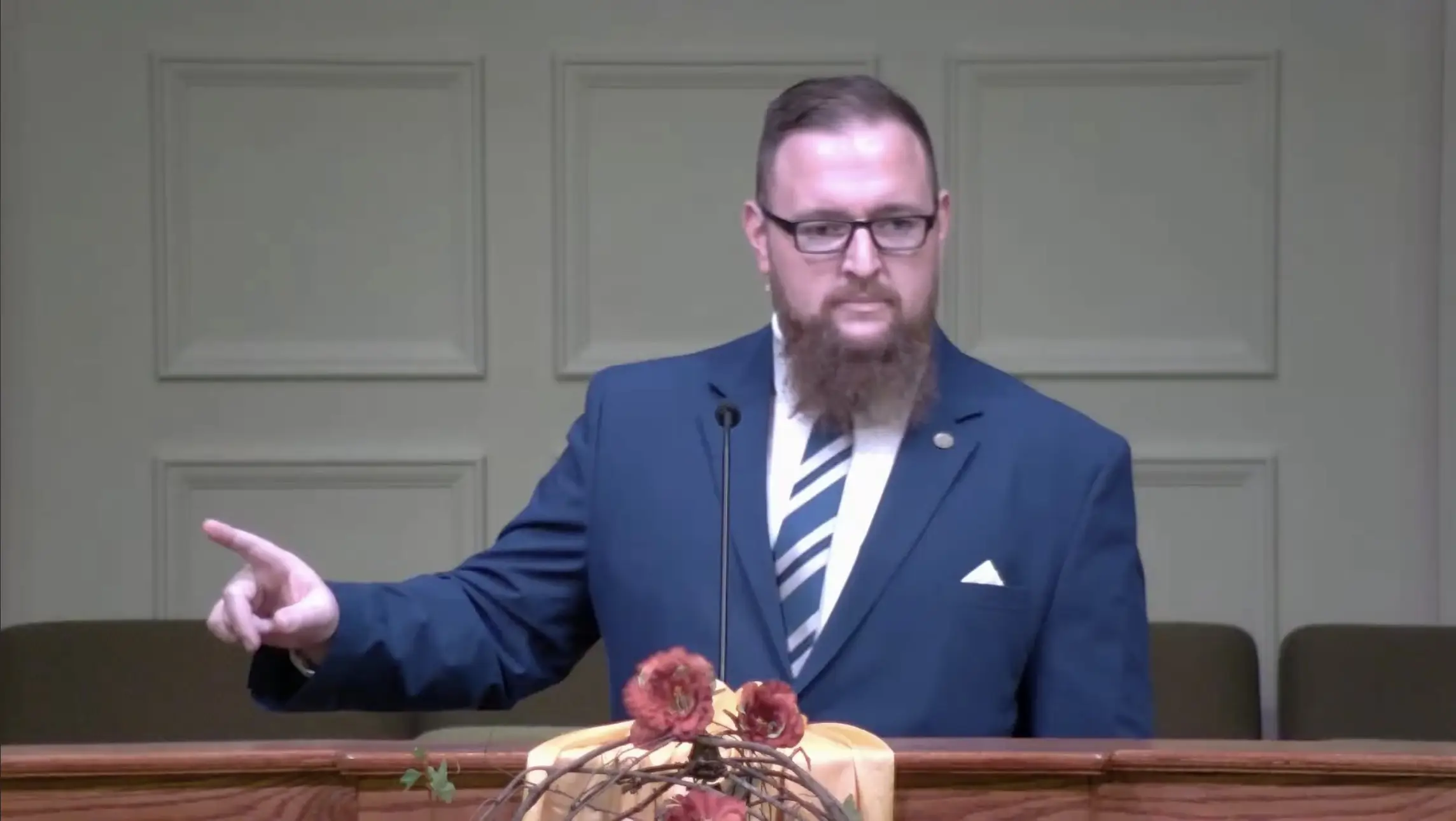
Video
“Does This Cause You To Stumble?”
John 6:59-65
Pastor Ryan J. McKeen
03/15/2026
Audio
Transcript
Well, turn with me in your Bibles to John chapter six. John chapter six. As I mentioned before, we have come now to the end of Jesus’s sermon here in Capernaum. Jesus has been preaching to this crowd about being the bread of life. after feeding them at the beginning of chapter six with the five loaves and two fishes as he fed the 5,000 men plus women and children.
And now he tells them that he is the true bread, the bread of life that has come down from heaven, and that if they wanted eternal life, they had to come and partake of him. As he said in our last text a few weeks ago, they needed to eat his flesh and drink his blood. And as we saw, that was a metaphor. And Jesus explained what he meant by that. In verse 47, he says, truly, truly, I say to you, he who believes has eternal life.
That is what they had to do. They had to believe. And all of this is following Jesus’ teaching to them that God had to work in them in order for them to believe. You remember from verse 44, no one can come to me unless the Father who sent me draws him and I will raise him up on the last day. And yet he tells them that they must come to him. They must believe if they are to have eternal life. So the implication here is, if you do not believe, it is because the Father has not drawn you, and if the Father hasn’t drawn you, you won’t have eternal life. And this is a difficult teaching to understand and to digest. It is hard to think that it is God who determines these things. Yes, we must believe, but it is God who works in us to make that happen.
What we see in our text here today is the aftermath of Jesus’ difficult sermon. What we really see are two different responses. One we’ll look at this week, and the next one we’ll look at next week. The first one that we will focus on today is unbelief. This is the first response we see following the words of Jesus. And again, next week, we will see the belief of Jesus’ disciples. But today, we will focus on this first response, and we’ll see three elements of the response of unbelief to the words Jesus spoke. First, we see that it was a difficult statement. So number one, the difficult statement. Secondly, the divine solution. And then lastly, number three, we see the determining factor.
And that all comes from our text this morning. This morning we’ll focus in on verses 59 through 65 of John chapter 6. Again, the following response to what Jesus has just preached to them in the preceding section of John 6. Now we start at verse 59 and see the response. So please follow along as I read John chapter 6 verses 59 through 65.
This is the word of the Lord. These things he said in the synagogue as he taught in Capernaum. Therefore, many of his disciples, when they heard this, said, this is a difficult statement. Who can listen to it? But Jesus, knowing in himself that his disciples were grumbling at this, said to them, does this cause you to stumble? What then if you see the Son of Man ascending to where he was before?
The spirit is the one who gives life. The flesh profits nothing. The words that I have spoken to you are spirit and are life. But there are some of you who do not believe. For Jesus knew from the beginning who they were who did not believe and who it was who would betray him. And he was saying, for this reason I have said to you that no one can come to me unless it has been granted him from So we begin here with, in verse 59, some contextual details that John gives us.
He’s already told us that this was in Capernaum, but here he clarifies that this sermon was preached in the synagogue. They’re in Capernaum. So it’s not as though they were just standing along the side of the road or in a field like they were with the feeding of the 5,000. This all took place, as verse 59 says, in the synagogue, in a formal teaching setting.
And then we see here the first element of this response is that this was a difficult statement. That’s what they call it there in verse 60. Again, therefore, many of his disciples, when they heard this, when they heard everything that Jesus has taught and spoken to them as he was preaching there in the synagogue, as they heard this, said, this is a difficult statement. Who can listen to it? So it’s not only the Jews, as we saw in verse 52, that John characterized the non-believing respondents as, but it says many of his disciples were finding Jesus’ teaching hard to take. And in John’s gospel, even though he clarifies the Jews as many of those who don’t believe, many of the opposition to Jesus, the dividing line is not simply their ethnicity.
It’s their response to Jesus. That’s what sets them apart from the disciples. And we know that because the 12 disciples were Jewish. It wasn’t their Jewishness that was preventing them from understanding. There’s a lot more going on than that. But it does say his disciples here had a problem with this. So who are they? Who is this talking about as his disciples who are having a problem with this?
Well, one thing we need to understand about that word disciple, it doesn’t always mean a faithful, believing follower of Jesus. A disciple could simply be one who followed a teacher, one who learned from a specific teacher and was a student of theirs.
So really, all of these crowds that had been following Jesus around, because they’re following him, in some sense, are disciples. And that’s really what this word is speaking of here in verse 60. Those who were following him were saying, this is a difficult statement. And we know later on in the next section there in verse 66 and 67, Jesus specifies the 12. as those who did believe, who were also disciples, but there’s a difference here between the disciples who have a hard time with this and the 12 who do not abandon him. And so while large crowds follow Jesus, especially early in his ministry, as we’ve seen over and over, most of them are just simply entertained by the amazing miracles that he can do, especially healing their diseases. or feeding them as they came to him for more bread already in chapter six. But these disciples mentioned in verse 60, these are those sign seekers, not the truth seekers.
They are attracted to Jesus by the miracles that he can do, the cool tricks he can perform. by the meal they had eaten, or even as we saw earlier, by the hope that he would deliver them from the Romans, because they wanted to take him by force and make him king. And still, even though they’re not following him for the right reasons, at this point, up until now, they were following him. They hadn’t abandoned him yet. Till this point, they were still following him around, and so they are called his disciples or followers.
But again, they’re not the 12. They have a completely different response to Jesus here. Here is where we start to see the distinction becoming clear. The division between these two groups is how they respond to Jesus, and it shows who they truly are. Again, the 12, as we’ll see next time, minus Judas, of course, truly believe and stay with him. And the disciples, or followers here, eventually stop following, and they’re no longer disciples.
And they do so, again John clarifies, because they said, this is a difficult statement. This is a difficult statement. The reason they leave him is because Jesus’ teachings are difficult, they’re hard. But what does that mean? What does it mean that they’re difficult?
Well, the word there that’s used, the Greek word, helps us understand that. The word is skleros, and it does not mean hard to understand. It’s not that they misunderstood him. The word means hard to tolerate, hard to swallow. Hard to accept. It’s not that they misunderstood him, it’s that they didn’t like him. They didn’t like what he was saying. They didn’t want to hear that. It was difficult to understand, not to understand, difficult to accept. It was not incomprehensible. It was unacceptable. When we see that these people did understand him, that’s when they leave. They split. See you later. I don’t want any more of this.
Because when Jesus’ followers don’t understand him, they stay and they ask questions. What did you mean by that parable? What does this mean? We don’t understand you. But when they do get it, and they don’t like it, That’s when we see what we see here. This is a difficult statement. Who can listen to it? Who can stand around here and listen to what this guy’s saying? Can you believe this? It’s not that they didn’t understand it.
They didn’t like it. And what were these teachings that Jesus was giving this crowd that was so difficult, so hard for them to accept? The things that they didn’t like. Well, in his follow-up here, Jesus goes to touch on them again. He emphasizes the things they don’t like, once again, like pouring salt into their open wound here. He confirms their unbelief by reemphasizing these difficulties. So what were they? Well, they’re the same ones that people have a hard time accepting today, that Jesus is God, that Jesus had to die and that God is completely sovereign. That’s what he’s been saying. First, there’s the incarnation and all that it means.
Jesus said that he was the true bread that came down from heaven, that he was from heaven. He came down from heaven. Isn’t this Jesus, the one who’s from Joseph and Mary? We know him. What is he talking about? He says he comes from heaven. This Jesus we know, he’s from Nazareth. We know this guy. No, he says he’s from heaven. He existed before. He existed before he came and was born of Mary. He was God’s son. He has a divine nature and he has come as God to take human nature on himself.
And these crowds, those who Jesus tells this to, even as we see later on, they know what he means. They don’t misunderstand what he’s saying to them because they charge him with blasphemy. That’s how you know that they got it. It could only be blasphemy if they actually understood that Jesus was claiming to be God in the flesh. That’s the blasphemy. God’s come in the flesh? Absolutely not. We don’t accept that. How dare you say that? This is what they were choking on.
This is what they were finding hard to accept. that he came from heaven, that he’s God in the flesh. And there are still many today who don’t accept this. Secondly, Jesus was telling them, he was teaching them that he needed to go to the cross, that he had to die. We saw in verse 51, Jesus said, the bread which I will give for the life of the world is my flesh. He will give his flesh. And this is hard to accept. Even today. Even his believing followers had a hard time accepting this. Remember Peter. Jesus, no, we’re not gonna let you die. What are you talking about? We won’t let that happen.
Get behind me, Satan. And this is hard to accept even today. that Jesus has to die for me. If you tell me that I should pay for my own sin, okay, that makes more sense. That is how the world works. You mess up, you pay the price. We even understand that someone should die if the crime is bad enough. We get that. And so we would understand that salvation must be earned if that were possible. I mess up, I have to fix it. But to think that Jesus Christ earned my salvation for me. And that these people, as he’s telling them this, they would have to receive salvation as a free gift. or not receive it at all.
Now that’s a problem. Now that is hard to accept. And this is the main difficulty that most people have in accepting Christianity. What do you mean that I can’t do anything? I have to do something. Giving up control of my own destiny and trusting in the saving work of Jesus Christ. That’s the hard part. That’s what’s hard to accept. And thirdly, the third thing that they were finding hard to accept was the very reason why they couldn’t believe. And that is God’s sovereignty.
Jesus had just taught them that the reason why most of them listening did not believe was because the Father had not given them to Him. It was because they could not believe. They haven’t been given the ability to believe. And that they could come to Him and believe eventually only if God had previously given them to Him. And we know the response here. But, but, but, but whosoever!
No one can come to me unless the Father who sent me draws him. All that the Father gives me will come to me. Verse 37. Verse 45, everyone who has heard and learned from the Father comes to me.” And he will say it again in our text today as he reminds them, for this reason, this very reason that you are choking on this, for this reason I said to you, no one can come to me unless it has been granted him from the Father.
You see, nothing in all of Scripture gets people more worked up than this very teaching, that God’s in control of it. We’re not. Yes, we’re responsible to respond in faith and to follow Him, but God’s in control of it all. And it’s true. It’s hard to accept. But it’s true. And Jesus didn’t hesitate to preach this. He’s repeated this. In each one of these teachings, they fly in the face of the normal way of thinking of that day. And they fly in the face of the normal way of thinking today.
The question is, are we willing to change our opinions to conform to the Word of Christ, to what Jesus clearly says? We must have our minds corrected by Jesus’ teaching. This is their very problem. We must learn to evaluate our opinions on especially spiritual matters Not by our own understanding, by what God’s word says. If God’s word plainly says it, then it’s true. And that is the case with each of these three teachings of Jesus that offended these people. Jesus is God, Jesus had to die, and God is completely sovereign.
This is a difficult statement. Who can listen to it? That’s our first division of this text is the problem that these people were having. The difficult statement. The hard to accept statement. And next we see the divine solution. The divine solution starting in verse 61 here. knowing in himself that his disciples were grumbling at this, said to them, does this cause you to stumble?
He knew. He knew what they were thinking and what they were saying. He knew what was in man. If you remember from chapter two, after the cleansing of the temple, Chapter 2, verse 25, he had no need that anyone bear witness concerning man, for he himself knew what was in man. This is what he’s talking about. Nobody needs to tell him whether or not they believe. He knows. And again, what we’re about to see in verse 64, Jesus knew from the beginning. He knew from the very beginning. who they were who did not believe, and who it was who would betray him. He knew.
He knew, so he asked, does this cause you to stumble? That word there is the Greek word scandalizo. Does this scandalize you? Do you have a problem with this? This is what’s too hard for you? And listen to what his response is. This is too hard for you.
Verse 62, what then if you see the son of man ascending to where he was before? What’s he talking about there? A lot of commentators, they think this is pointing forward to his crucifixion and ascension. Like, just wait until you see this. If you think this is hard, wait until you see. But that really doesn’t make a lot of sense as to what he’s talking about. Why would that be hard for them or make them stumble? I don’t think Jesus is pointing forward here. I think he’s pointing back. That’s why he said before. He says, what if we go back to the way it was before?
You think this is hard? This causes you to stumble? I’m providing you a way of salvation where I die in your place. And you think that’s the hard way? What if I never came? What if I left you to your own devices? What if I went back to where I was before? What if I left you to figure it out yourself? No, this isn’t the hard way. That was the hard way.
But this is the only way that we get. This is the only way of salvation that there is. I am the way, the truth, and the life, and no one comes to the Father except through me. This is the only way. and it is only understood and accepted by the work of God in your heart.
That’s what he says next. Verse 63, the spirit is the one who gives life. The flesh profits nothing. The words that I have spoken to you are spirit and life. Spiritual life comes only when the spirit gives that life. The life we have, the eternal life, the spiritual life, is not of us. We didn’t do it. We didn’t cause it. Our life is in Christ through the Spirit.
Galatians 2, verse 20, I have been crucified with Christ, and it is no longer I who live, but Christ lives in me. And the life which I now live in the flesh, I live by faith in the Son of God who loved me and gave himself up for me. In Colossians chapter three, for you died and your life has been hidden with Christ in God. When Christ who is our life is manifested, when he’s revealed, then you also will be manifested with him in glory. Life comes by the spirit. It’s nothing to do with anything we can do. It’s not of us. It doesn’t come through the will of the flesh, as John 1 13 says.
And you can see that in these people. They were disciples, they were following Him. But following Jesus around in the flesh profited them nothing. Because they didn’t believe. Jesus was saying that it’s His words that were needed. Not just being in His presence, eating the bread that He made for them.
They needed to hear and believe. And the Spirit gives life. His words are what they needed. The words that I have spoken to you are spirit and life. You’re missing it. You think you just need to be around me and follow me around. You’re missing my words. That’s what you need. Because without belief, anything physical profits us nothing. All of the external actions and external trappings of religion are no good for you if you don’t believe.
It is the word of God as it is carried into our understanding by the Holy Spirit that gives us life. And this is true of any practice of religion, even our practices of religion. Baptism is a wonderful thing. It is commanded by Jesus himself, but the physical act of baptism doesn’t save anybody. Baptism is only to reflect what’s already true inside of us, that we believe and we’ve been buried with Christ and raised to new life. Communion is another example. The Lord’s Supper is a great blessing to us. as believers. But the physical elements of communion don’t save anybody. And the fact is that communion, the Lord’s Supper, or as some call it, the Eucharist, it is taken regularly by multitudes of people who don’t believe.
And it does them no good. Those elements that people take are completely meaningless and worthless if they don’t believe. The works of the flesh profit nothing if the spirit does not give life. This goes the same with even our Bible reading and our prayer and our church membership. All of those things are great and wonderful things that we ought to be doing. But if you don’t believe, What good are they? All of those things are of great value to the one who believes, but when they’re practiced by unbelievers, they profit nothing. Without the work of the Spirit granting belief and life, anything in the flesh profits nothing.
Again, this goes back to our discussion last time, a couple weeks ago, of this transubstantiation view of communion in the Lord’s Supper that many people get from John 6, where Jesus says, you have to eat my flesh and drink my blood. The transubstantiation, the belief that the bread and the wine actually turn into the flesh and blood of Jesus, and that they infuse grace and salvation to the one who takes them. No, Jesus says, the flesh profits nothing. You can do nothing to save yourself.
It’s belief that saves. Belief in his words. My words are spirit and life. The words that I have spoken to you. Our spirit and life. Jesus is getting down to brass tacks with them. This is what you need. My words, believe them. You don’t need the signs. You don’t need the bread. You don’t need to keep following me around town to town and just being close to me and watching me do these miracles. My words, our spirit and life, He who believes has eternal life. You people keep following me, but you’re missing everything, because you don’t believe.
This is Jesus’ solution for them. Even after He clearly explains all of these things, and they respond in unbelief, this is a difficult statement. Who can listen to it? Jesus still provides them with the solution. Look, it’s my words, believe in me. So that’s number two, the divine solution. Again, this is not the hard way, but it’s the only way. Belief in Him. It only comes by the Spirit, who is the one who gives life. And lastly, we see, we’ve seen the difficult statement, the divine solution. And lastly, we see the determining factor. The determining factor for these people.
Verse 64, but there are some of you who do not believe. For Jesus knew from the beginning who they were who did not believe and who it was who would betray. See, here’s the problem. There are those who do not believe. And as always, with those who reject God’s offer of salvation, the issue is not lack of information. It’s lack of faith.
You have what you need to believe. Now believe it. You don’t need any more information. This is the truth. Jesus is who he is. He has done what he has done. The bottom line is, do you believe it? And Jesus held these false disciples, these followers of him responsible. for not believing in Him, for rejecting Him. And it wasn’t because they couldn’t understand, but because they wouldn’t believe. But again, this doesn’t surprise Jesus.
This doesn’t surprise Him because He knew. He knew who they were who would not believe in Him. He knew from the beginning. He knew from the beginning who didn’t believe. And John says, he knew who was going to betray him. Jesus wasn’t surprised by any of it. He was grieved by it, but he wasn’t surprised. He knew the whole time. This is why the entirety of Jesus’ life was obedience, because he knew.
He knew who they were who did not believe and who would betray him. And he did it anyways. He knew who Judas was from the beginning. And he chose him as a disciple anyways. He put up with his presence for three years anyways. because he knew this is how it had to be.
Jesus wasn’t taken surprise by the cross or anything that led to it. He knew it was happening the whole time, and he still went. This is why he pleaded with the Father, if there’s any other way, take this cup from me, because he knew He knew everything. And He still went to the cross.
Because He had a people in mind. That He was saving for Himself. He still went. And if you believe, He had you in mind. He had you in mind. When He went to the cross. Because He knew from the beginning who it was who would not believe. And He knew who would believe. He knew who the Father gave Him. And those are the ones He went to the cross for.
And He follows up this incredible, monumental revelation about Himself. It’s hard to find a verse of scripture that’s more significant than that Jesus knew who it was who would not believe, and he knew who it was who would betray him. And he follows that up with saying, for this reason I said to you, that no one can come to me unless it has been granted him from the Father.
For this reason. For this reason. This is why I was saying what I said. For this reason. This is why I told you in verse 44, no one can come to me unless the Father who sent me draws him. And I will raise him up on the last day. This is why I told you. He’s reassuring his true disciples here. I have it under control. I know. I know who it is who believes and who doesn’t. This is why I told you. I wasn’t just guessing here. I wasn’t making a prediction.
Jesus knew who it was because of the sovereignty of God in salvation. It’s the only way. It’s the only way he could know. He knew who it was because he knew who the Father gave him. He wasn’t preaching to this crowd in this synagogue and thinking, oh, I really hope that they believe in me. He knew. He knew every single face looking at Him and whether or not they would believe and whether or not they wouldn’t. He knew.
And still, He gave them His words. He still preached to them. even though the masses hear. He just fed 5,000 men and women and children, and they follow him, they come to Capernaum with him, and they’re all packed into this synagogue, and then they leave after this. He still preaches to them, even though he knew. And how many does he turn to and say, are you gonna follow? Are you gonna leave too? How many actually stayed? 5,000 men plus women and children, how many stayed? The 12. 12. Looking out at a crowd of thousands, there’s 12 who stay. But he still preaches the gospel to them. He still gives them the truth. And that should tell us something. That should teach us something.
The sovereignty of God in salvation does not get us off the hook in evangelism, in sharing the gospel. We cannot say, well, God will save who he wants to save, so I’m gonna leave it up to him. That is not how this works. That is not what Jesus did. No, we still go and we still tell them. Because He didn’t tell us who it is.
And yes, God will save who we will save. That’s true. But He will use us as the means through which the ones who are His will hear and repent and believe. That’s how this works. That’s how he designed this to work. That’s why we go. That’s why we preach. Because he’s got sheep out there. And the sheep hear his voice. And they know him. And they follow him.
So what will you do with Jesus’ words? Will you listen or will you turn away from them like many of his followers did? You do realize if you listen, you’re not in the majority. It is true that no one can come to Jesus unless the Father draws him. But again, this doesn’t eliminate our responsibility to listen to Him and believe and obey His words.
Listen to the balance in Jesus’ statement here. He says, the Spirit gives life. That’s God’s sovereignty. In that work, God operates by Himself. and no one participates with him. God is the one who gives life. God is the one who draws and brings us to himself. But Jesus goes on to say, the words that I have spoken to you are spirit and life.
To you means human responsibility. The words of Jesus are directed at you. Do you believe them? If you’re not a Christian here this morning, you’ve heard the truth. It’s your obligation to read and hear God’s Word and to see your own sinfulness in it, to see your need for a Savior reflected here in this passage of Scripture. You need Him. He’s offering himself to you. This is the way of salvation. He gave us his words and his words are spirit and life. So do you believe them? Do you feed on Jesus’s words? Do you digest his words and live on his words?
There are many other things in life that can distract you from this. Other things that seem more important, more entertaining, more valuable. They tried to distract him. He knew, and he still gave us the truth. He still gave us his words. And that is what we must do.
So if you are not a believer, you need to come to Him and believe in His words. Come to Him today. Don’t leave here today without talking to somebody about your need for Christ, your need for a Savior. And if you are a Christian already, you need to bring His words to those around you. They need to hear them. Proclaim Jesus’s words to those who will receive them and even to those who won’t.
To everyone. Because that’s how this works. This is how he brings his own to himself. Through us. And as you proclaim his words, God will use them to draw men and women to himself. This is the gospel. This is the good news. This is the only way. Let’s stand and close in order of prayer this morning.
Our God, we thank you. We thank you for your word. We thank you for your willingness to send your son for us. We thank you for his willingness to obey, to continue to give the truth, to continue to obey all the way to the cross, to the point of death, even though he knew who it was who would not believe. And we thank you that he knew who it was who would believe. that he had us in mind when he obeyed you all the way to the cross. God, we thank you. We could never thank you enough. We thank you for our Lord, who is our salvation. We pray this in Jesus’ name, amen.