
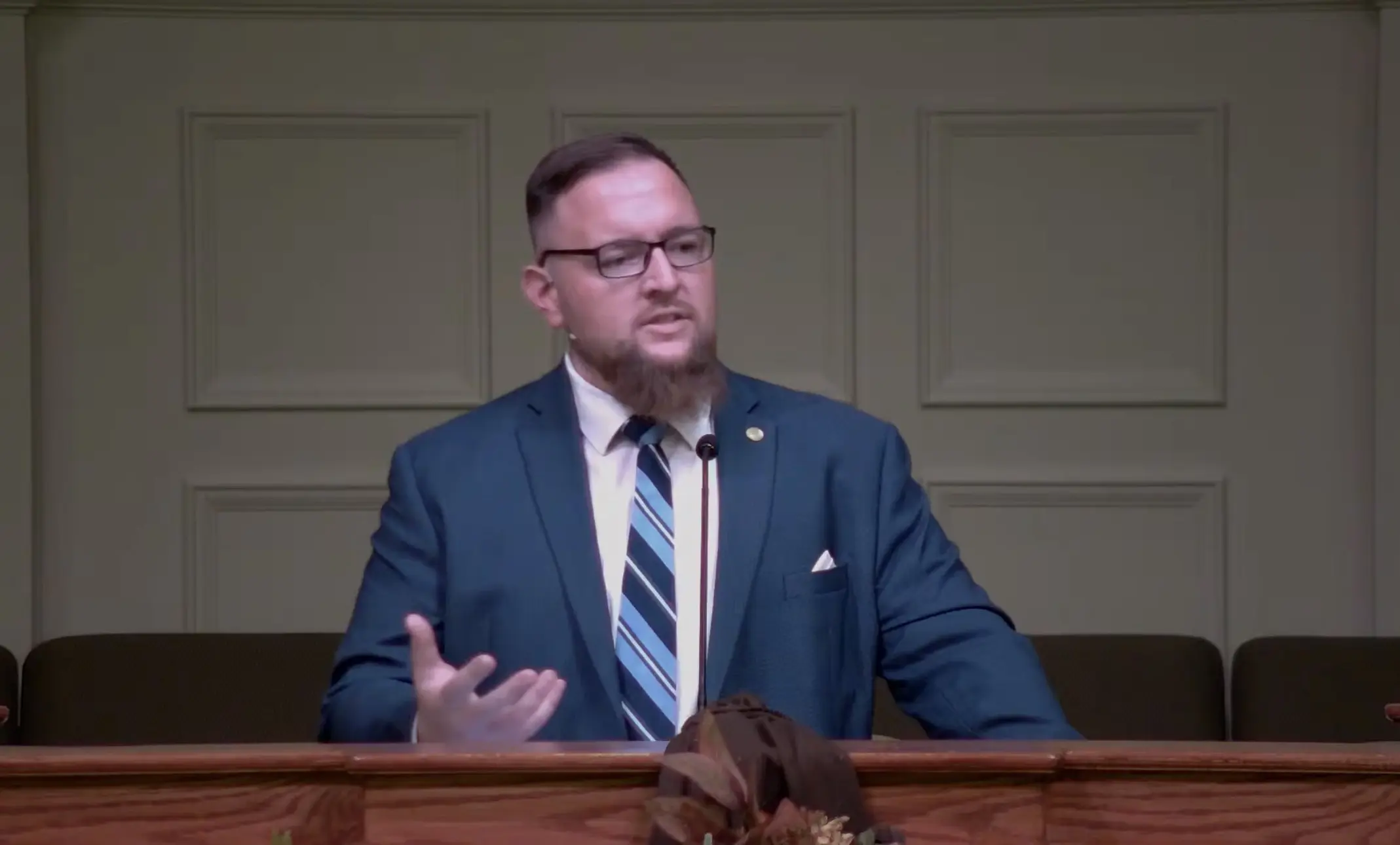
Video
“You Do Not Believe Because”
John 10:22-26
Pastor Ryan J. McKeen
11/08/26
Audio
Transcript
Turn with me in your Bibles to John chapter 10. We’ve finished Jesus’ teaching on the good shepherd. We come now to the final portion of the 10th chapter of John’s gospel. And because there are 21 chapters in the gospel of John, we’re halfway through chapter 10.
You would think that we’re about halfway through the life and ministry of Jesus. But that would be incorrect. Actually, this passage begins the end of Jesus’s public ministry. And as we’ll see in a few moments, when we look at the change in time here in this chapter, there are only a few months left in the life of Jesus.
This study of John’s gospel has been tremendous for me, for us as a church. I’ve known Jesus almost my whole life. And through studying his life in this series through the gospel of John, these first 10 chapters, I feel like I know Jesus more now than I’ve ever known him.
And at the same time, I feel like there’s so much more. There’s so much more to know about Him. When you come to Christ, it’s, when you first become a believer and you come into the body of Christ and you come in Christ, it’s like you’re coming in from the dark and the cold and that simplicity of Jesus and who He is and being in Christ for the very first time is just so much better than where I was. It is such a difference and it is so much more than life could ever be outside of Him. But the longer you’re in Christ and the more you look around and explore it as if it’s a room that just keeps getting bigger and more and more detailed and better and better. And it’s not as though what you knew before was any worse than what you know now, but it’s more and better and it just keeps growing. And there is so much more and more you can know and experience and love him. That’s what it is to be in Christ. The more you know him, The more grateful you are for him, the more you realize what you have in him, and the more you realize what you don’t yet know about him.
And that’s what it’s been like in this study in John chapter 10 and John’s gospel all the way through. Again here, starting at verse 22 where we’ll pick up this morning and really through the end of chapter 10 is this last public interaction in Jesus’ life. His last, at least publicly, interaction between these crowds and these Jewish leaders, and then John spends the entire second half of his gospel explaining the last few months of Jesus’ life. As you remember, this setting that we’ve been in These few days that have passed began really back in chapter seven, as we came to the Feast of Booths. And then all the way through now, chapter 10, verse 21, only a matter of days has passed. But now you come to verse 22, and we see a period of months have passed since verse 21. And we’ll pick that up, and I’ll explain that a little more later. But again, what’s important to see here is time is running out for these people. even though they don’t yet realize it, but their time of having Jesus in their presence was about to be over.
Just like the scripture said would happen, the nation of Israel, led by their religious leaders, would reject their Messiah. We read it many places in the Old Testament, but as Isaiah speaks about the servant that would be coming, Isaiah chapter 49, verse 7 says, thus says Yahweh, the Redeemer of Israel and its Holy One, to the despised one, to the one abhorred by the nation. They abhorred Him. They hated Him.
By the end of His life, Jesus only had a handful of followers, and even the 12 deserted Him. later after his resurrection and appearance, to all these people who knew that he died. And he appeared to them publicly and showed them the marks in his hands and his side.
Even after all that, the book of Acts mentions there were about 120 in Jerusalem. 120. 120 people. Fewer people than are here this morning. After He had fed crowds of 4,000 and 5,000 men plus women and children, 120 people. After seeing someone raised from the dead, 120 people.
Preaching in Acts chapter 2 condemns this nation for rejecting their Messiah. Acts 2 verse 23, this man, Jesus, the one who appeared before them, this man delivered over by the predetermined plan and foreknowledge of God, you nailed to a cross by the hands of lawless men and put him to death. They condemned the one who came to save.
But He still came. Because He knew that He had sheep to gather. Sheep that would believe in Him. Even though the crowds and the leaders rejected Him, He was going to do what He came to do. Which was to go to Jerusalem. And to die on that cross in the place of sinners who would believe in Him. The sheep.
And now here in John 10, we see one last interaction between these Jewish leaders and Jesus before Jesus’s ministry turns private. He’ll spend his last few months focusing on his disciples and preparing them for his death. Before he’s arrested and put on trial and crucified.
And we’ll cover those things in the coming chapters. But here in our passage today, we begin a new dialogue and for the first time in a while, a new setting. We’ll only begin this section today and we’ll focus on verses 22 to 26. What we see here is, again, John highlighting the unbelief of the general public. As we move along, especially in chapter 11, we start to see belief highlighted again, those who do believe. But here at the end of this chapter, John is focusing on those who don’t believe. The unbelief of the crowds and the Jewish leaders who he simply identifies as the Jews.
And the way we’ll do this is, as I often like to do, we’ll start in the shallow end of the pool. The things that we can easily grasp. The setting, the context, all those things. But I’m also gonna take you to the deep water. The deep water where you can’t touch bottom. And then we’ll come back to the shallow, simple gospel. And in this passage today, we will cover, what we will see is, first of all, the setting.
The setting changes, and we’ll have to talk through that a little bit. Secondly, the suspense, supposedly. And then thirdly, the sovereign shepherd is revealed. So the setting, the suspense, and the sovereign shepherd. Allow me to read our passage this morning, John chapter 10, verses 22 through 26. At that time, the feast of dedication took place at Jerusalem.
It was winter, and Jesus was walking in the temple in the portico of Solomon. The Jews then gathered around him and were saying to him, how long will you keep us in suspense? If you are the Christ, tell us openly. Jesus answered them, I told you and you do not believe. The works that I do in my Father’s name, these bear witness about me. But you do not believe because you are not of my sheep.
As John typically does when the scene changes, he takes the time to explain that to us. And he introduces this passage by explaining the setting. That’s number one that we’ll cover this morning. And first he mentions the change in time. And in our version this morning, it says, at that time. But that’s a little bit confusing to us. The phrase really is meant to show the progress of time.
So you could say it, then came the feast of dedication. Again, tracking the timeline of events that have happened. The Feast of Booths had just happened, and that usually takes place around October on our calendars. But the Feast of Dedication is in December. So some time has passed now. The Feast of Dedication, again, happens at the end of the calendar year. It is what we usually celebrate or see celebrated as Hanukkah. That’s what the name for it is today.
In Jesus’ time, it was a relatively recent addition to their feast calendar. They had feasts prescribed in scripture already, but this was one that they added onto what they had already done. It was, again, not mentioned in the Old Testament law, but it was instituted to celebrate their religious freedom that was won years earlier. In fact, it was in 167 BC, so just about 200 years before what’s taking place in John 10.
But in that time, there was a Syrian conqueror named Antiochus Epiphanes, and he came to Jerusalem, and he desecrated the temple when he conquered it. He set up a pagan altar in the temple to replace Israel’s altar. And not only that, he sacrificed a pig on it in the temple, in the Jewish temple.
And this, of course, was seen as supremely wicked. and offensive by the Israelites. Eventually, they began to fight back. They grew stronger and stronger, and eventually, under the leadership of a man named Judas Maccabeus. You may recognize that name from some of the apocryphal books, the books of Maccabees, but his name was Judas Maccabeus, which means Judas the Hammer, which is a really awesome name. That could have been a really popular name Until Judas Iscariot had to come and ruin it. But, Judas the hammer conquered the Syrians and they recaptured the temple in the city. And when they did that, they held a celebration for eight days. And to recognize that time and that celebration, it was decreed that a similar eight day feast should take place every year.
And that’s the feast of dedication. Or as we mentioned it today, it’s Hanukkah is the name it’s used for today. But again, this time of year that verse 22 picks up at is this feast of dedication. And again, it wasn’t biblically prescribed, so the crowds weren’t the same as they were at the Feast of Booths. At the Feast of Booths, everyone had to come. The Bible said so. The law was you had to come and celebrate these feasts. But this feast that had been added, they could celebrate it at their homes. So while it was a time of festival, it probably wasn’t nearly as busy as it had been.
And John tells us the time period in verse 23, it says, it was winter. And Jesus was walking in the temple of the portico of Solomon. So this feast, as we know, takes place in winter, which would explain why Jesus would be in this portion. It was probably cold.
And that time of year over there is the rainy season. And the portico of Solomon was a section of the temple that had a roof and held up by pillars there. And many people used that area of the temple for teaching like this in the bad weather parts of the year. Later, early Christians would gather here to preach the gospel of Christ. We see that in the book of Acts, in Acts chapter 3. Verse 11, it says, while he was clinging to Peter and John, all the people ran together to them at the portico called Solomon. So in this very place in John 10.
And when Peter sees this, he replies, men of Israel, why do you marvel at this? Why do you gaze at us? As if by our own power or piety, we made him walk. The God of Abraham, Isaac, and Jacob, the God of our fathers has glorified his servant, Jesus, whom you delivered and denied in the presence of Pilate. when he had decided to release him. Just think of that.
A few years later, these disciples who are with Jesus are back in this very same place in the portico of Solomon preaching about this Jesus. We see it again in Acts chapter five where they’re there again preaching, preaching the gospel of Christ in Solomon’s portico. And this is the very place where Jesus is walking here at the Feast of Dedication in the winter. This is the setting that John gives us in these first two verses.
And next, John tells us about, secondly, the suspense. And in my notes, I have the word suspense in quotes. Because while the Jews call it suspense, there’s really no suspense here. Verse 24 says, the Jews then gathered around him, And they were saying to him, how long will you keep us in suspense? If you were the Christ, tell us openly.
The Jews gather around him. You can see the picture, Jesus coming into this portico of Solomon, an open area with the pillars and roof, and the Jews gather around him. That word is to encircle him or surround him. They’re probably waiting for him. Probably knew he was coming. and they seize their opportunity to surround him and question him one last time.
And they say, how long? How long will you keep us in suspense? Literally, this says, how long will you keep taking our life away? Or you could say, you’re killing us. Tell us already. And you might be thinking, well, what’s he hiding from them? What isn’t he telling them? What are they in suspense about? And they continue, if you were the Christ, tell us openly. What? What do you mean? What do you mean, tell us openly? What have you guys been doing?
That’s what you’re dying to know. This is what you think he’s hiding from you. But that’s how you know this question isn’t an honest question. They don’t really want to know. What they want is in the second half of their question, where they say, tell us openly. Tell us publicly in front of all these people. Now that we have some other people around, tell us again. Say it again, Jesus. Tell us openly. If this was happening today, you’d see them all with their phones out and recording. Say it. Go ahead, say it. They want to get it on record because they aren’t looking for the answer. They’re looking for evidence. They’re looking for evidence they can hold against him.
They’re trying to get him to entrap himself because they don’t see his claim or the truth about being the Christ or the Messiah as a glorious truth that could actually save them. They see it as blasphemy. that they can use to condemn him. You see, he was the greatest threat to their power and importance in life. If he was really the Messiah, well then they’re not so important anymore. So they’re desperately looking for a way to discredit him and to find him guilty so they can get rid of him. They were afraid of the negative attention that he would bring them. The negative attention from the Romans, the rulers of theirs at that time.
We’ll see that in the next chapter after he raises Lazarus from the dead. He brings the guy back from the dead and their greatest concern is, quick, we got to cover up the evidence. Don’t let anybody know that. John 11 verse 48, if you want to turn over a page, this is their reasoning. The Sanhedrin come together after this and they say, in verse 48, if we let him go on like this, all will believe in him. And the Romans will come and take away both our place and our nation. Oh no, if we let him go around and raise people from the dead, can you imagine what will happen? This is how ridiculous their unbelief is.
So their strategy was to get him to declare himself publicly again, so they can use it against him. This is the so-called suspense that they were waiting for. But again, there really is no suspense. He hadn’t hidden any of these things from them. And what he says next reveals that. We’ve gone quickly through the first two points here, and here is where we’re going to spend the rest of our time on our third point. He reveals himself as the sovereign savior. He continues in verse 25.
Jesus answered them. So to their question, their, tell us openly, are you the Christ or not? Tell us. Jesus answered them, I told you and you do not believe. The works that I do in my Father’s name, they bear witness about me. Jesus says, I haven’t been keeping you in suspense. You haven’t been paying attention. You are not listening. I told you, and you do not believe. And not only did I tell you, I showed you, and you still don’t believe. Later, when they do use this very thing as evidence against him at his trial, this is Jesus’ defense. In John chapter 18 verse 20, Jesus is on trial. Jesus answered and said, I have spoken openly to the world. I always taught in synagogues and in the temple where all the Jews came together and I spoke nothing in secret. Jesus had done everything openly.
He doesn’t need to say it again openly. It’s not as though he was hiding it. He spoke and performed many signs and miracles for everyone to see, and when he did, they tried to cover it up and distract away from him. He was doing this openly. Most recently, he healed this blind man for everyone to see, and everyone did see. Earlier, in chapter five, he healed a man that was sick for 38 years. He has been doing this.
If people don’t believe his words, they can at least see his works and believe. He said that back in chapter five after he healed the man. Verse 36, the witness I have is greater than the witness of John. For the works which the Father has given me to finish, the very works that I do, bear witness about me that the Father has sent me. If you won’t believe his words. Look at what he’s doing. Look at what he can do. And if you honestly look at these things, you cannot deny who he is. What works did he do?
Well, there are seven signs that John structures his gospel around. Seven signs that Jesus does, and that’s what John calls them, his signs. The first one was the wedding at Cana, where Jesus turned water into wine. And all of these signs show us something about him. They point us to who He is and what He does for us. Here, He is our provision. He provides what we need.
And John says there in chapter 2 that this was the first of Jesus’ signs, and that the disciples believed in Him because of it. And secondly, in chapter 4, Jesus heals the royal official’s son. He showed his power over sickness and the unbelief of the human heart, because as he did this, he gave the man faith. Chapter 4, verse 50, Jesus said to him, go, your son lives.
The man believed the word Jesus spoke to him and started on his way. The third sign was healing the lame man. It was lame 38 years, and there Jesus showed us that we are completely unable to come to on our own. He comes to us and He saves us just like He did healing this man. And fourth was the feeding of the 5,000 where Jesus shows He alone can satisfy our hunger. Fifth was His power over creation and walking on the water. And then the sixth miracle is healing the blind man. And the seventh will come in the next chapter, raising Lazarus from the dead.
These are the seven signs that John uses in his case to support Jesus as the Christ, the Son of God. But if those seven are not enough to convince you, it’s not as though all that these Jews had was seven individual things that happened and that’s it. Like if you missed one of the seven, you’re out of luck. That’s all Jesus did.
No, in John chapter 20, John tells us, therefore many other signs Jesus also did in the presence of his disciples, which are not written in this book. But these have been written so that you may believe that Jesus is the Christ, the Son of God, and that believing you may have life in his name. John says, I could tell you more. There is so much more I could tell you.
But I’m telling you these things because these things are undeniable about who Jesus is. You cannot honestly see these things and not come to the conclusion that He is the Christ, the Son of God. And if you believe that, you will have life in His name.
But they don’t believe. That’s what Jesus says here. They don’t believe. We’re through six of the seven. Six of the seven signs have already happened. There’s not much time left. They’ve been given all of this evidence and they don’t believe. Again, verse 25, Jesus answered them, I told you and you do not believe. The works that I do in my Father’s name, these bear witness of me. How do they not believe? Why don’t they believe?
And here is one of the clearest statements about belief that Jesus makes in the whole Bible. One of the simplest and most revealing statements in the whole Bible is in our passage today. If you wanna know how salvation works, if you wanna know why some people believe and others don’t, this is your answer. This is it. Verse 26.
But you do not believe because you are not of my sheep. You do not believe because you are not of my sheep. That’s why they don’t believe. They’ve heard his word, he told them. They’ve seen his works, he showed them. And they do not believe. You do not believe because you are not of my sheep. This remarkable but simple statement is meant to be jarring and offensive. It’s meant to make you stop and think. What did he just say? What was that? Can you say that again? You do not believe because you are not my sheep.
And you’ll notice that when I’m preaching a verse that is highly offensive and difficult, I read it a bunch of times out loud because it’s his word and his word is living and active. And if I keep repeating his word, eventually it will sink in and have its effect.
But you do not believe because you are not of or among my sheep. Charles Spurgeon said about this verse, some theologians would like to read that you are not my sheep because you do not believe. As if believing made us the sheep of Christ. But, the text puts it, you believe not because you are not my sheep.
And Spurgeon is right. This verse explains the cause and effect of salvation. What came first, belief or being a sheep? And it’s not an unanswerable question. You believe because you’re a sheep. So the question of this verse is, are you a sheep because you believe or do you believe because you’re a sheep? And he says, you do not believe because you are not a sheep. You don’t become a sheep in Jesus’ flock by believing in him. You don’t turn into a sheep. That’s not how it works. A sheep is always a sheep, even before he realizes it. You believe in Jesus because, from God’s perspective, you are already a sheep. You are already his, and that’s why you believed in the first place. The sheep believe when they hear him call.
That is why Jesus said earlier in verse 16, I have other sheep from other folds. Jesus had not gone there yet, but he knows that they’re already his. He just needs to gather them. And as we saw, he gathers them through the preaching of his word, through his sheep. He already has sheep who have not yet believed in him.
So from God’s perspective, every person is already either a sheep or not a sheep. And no human ever changes his status from being a sheep to or from not being a sheep to being a sheep. God considers a person to be a sheep even before he or she believes in him.
And this makes sense when you think about it. This makes sense with what you see. Because here Jesus is explaining why. We’ve all seen people who believe. While others who heard the exact same gospel message refused to believe. And we know that the gospel changed me. I couldn’t help but believe. Why don’t they believe? Why didn’t it happen to them? That thing that happened to me when I heard it and I believed and everything changed. Why hasn’t it happened to them? They heard the same message I heard. Why don’t they believe? And Jesus is explaining why. Being a sheep explains why a person believes. And not being a sheep explains why a person does not believe.
Ultimately, it’s not a matter of us believing. It’s God’s work in and through us. God’s electing His sheep and giving them to the Son. Unless God does a work in a person’s life, drawing them to Himself, and that’s what He calls it in His Word, drawing and calling and giving them to the Son. Unless He does that first, no one comes to Jesus. No one believes unless He works in them. But you have to be among Jesus’ sheep in the first place in order to believe.
That’s what He is saying here. You have to be among that group that the Father gave to the Son before the foundation of the world. And by God’s electing and predestining, he brings all of the sheep to the shepherd. That’s why Jesus tells these Jews this clear statement here.
Tell us openly. You want it openly? You want it plainly here? You can’t say it any more plainly than he says it. They did not believe. And they claimed it was because they didn’t get the message. The message wasn’t clear enough. You didn’t say it openly. So tell us openly. But the message was clear enough. That’s not why they didn’t believe.
And there are many who believe this today. Well, the message isn’t clear enough, and that’s why there’s not enough believers. If we just simplified the message a little bit, if we tailor the message for unbelievers and make it not so hard and offensive, then we’ll get more. That’s how we’re going to get more. That’s how we’re going to get more believers. We need to appeal to them. If we can just get them in the door, if we can just get them in the door of the church, then they’re just gonna love us so much. They’re gonna just love it here so much that they’re gonna have to believe. Well, first of all, that’s a very inflated view of what unbelievers think of the church.
And secondly, that is not why they don’t believe. It’s not that they don’t believe because the gospel’s too offensive. or that it’s too hard to hear or understand, if it’s the true gospel, the sheep will believe. The sheep will believe it. And the problem for these Jews was not a lack of clarity or a confusion of the message. It was because they were spiritually blind. He just showed them that with the blind man. And remember, they asked, are we blind too? Yes, that’s the point. Yes, you are blind too. They couldn’t hear the shepherd’s voice because they weren’t his sheep.
And you can say, well, how is that a legitimate offer of salvation then? How can it be a legitimate offer if they can’t believe? Jesus said in John chapter five, verse 40, speaking to these Jews, you are unwilling to come to me so that you may have life. See there, if they were only willing to come, then they would have life.
It has to be a legitimate offer, because Jesus wouldn’t lie. But he says here, you don’t believe because you’re not my sheep. How can this be? And the answer is, it’s because it’s true. If they were willing to come, if they were willing to come to him, they would have life. That is a real and true offer. And the question is not, did they come? We know they didn’t come. If they did, they would have life, but they didn’t come, and the question is why? Why didn’t they come? And the answer is they couldn’t come, because they’re not His sheep. Just like the rest of us couldn’t come if God doesn’t act first, and bring us to Him.
God acts in the life of His sheep to call them to Himself. He chooses us and He predestines us and He calls us and He draws us and He regenerates us and He gives us eyes to see and ears to hear. And He gives us the faith to believe in Him when we do see and hear. And He justifies us and He sanctifies us and one day He will glorify us in every step of that process He does it. It’s all Him. All glory to God. Because none of it can be to me. What glory should I get? I did nothing.
He did it all. From the start to the finish. From the beginning, before the foundation of the world, His sovereign plan and choice of who would be His sheep, all the way through the process. He is doing it. We heard from Ephesians 1 earlier, Ephesians 1 verse 11, in Him we also have been made an inheritance, having been predestined according to the purpose of Him who works all things according to the counsel of His will.
It’s all passive. It’s done to us. We didn’t do it, He did. Yes, every single human being is responsible to believe, to come to him and respond in faith and repentance, but nobody can unless he does it. That’s what it takes to save us. We are responsible, but he is sovereign over it all.
How exactly those two biblical realities work together is beyond our comprehension. This is the deep end. This is the deep water. We can’t touch bottom here. But the Bible does not apologize for this tension. It’s here. Both are true. We are responsible. You would not come to me that you would have life.
But nobody can come to him unless they’re his sheep. and the Father draws them and does all of the things that it takes to save a sheep. We see this in other places as well. For example, speaking of Judas Iscariot’s betrayal, Jesus speaks of both human responsibility and God’s sovereignty in the matter. Luke 22 verse 22, for indeed the Son of Man is going as it has been determined. but woe to that man by whom he is betrayed.” It has been determined. It doesn’t get any more firm than that. This is what God chose to do.
This is what God said and determined would happen, that this man named Judas Iscariot would be born in this place at this time and grow up and become one of Jesus’ disciples and follow him around for three years and never believe in him and betray him for 30 pieces of silver as it has been determined. At the same time, woe to that man, Judas Iscariot. Would it be that he was never born? Judas’ betrayal, being exactly what God’s plan had determined, did not remove the responsibility of his crime.
I read Peter’s words earlier from Acts 2, but again, he says it there too. Acts 2 verse 23, this man, Jesus, Delivered over by the predetermined plan and foreknowledge of God. You nailed to the cross. By the hands of lawless men and put them to death. God planned all of this to happen and you’re guilty for it. God’s sovereignty and human responsibility. And God’s sovereignty does not excuse human responsibility.
This is exactly what Jesus says here to these Jews. Jesus answered them, I told you, and you do not believe. The works that I do in my Father’s name, these bear witness of me. He told them, if you would believe in me, you would have life. I told you, but you will not believe.
And you do not believe because you’re not my sheep. It is not just that his sheep hear his voice and he knows them and they follow him. And those are all points that he’s explained already. It’s not just that. But the opposite is true. Those who are not his sheep, they do not hear his voice. And he does not know them. And they do not follow him. But the fact that they’re not Jesus’ sheep does not excuse their guilt. It is the very thing that condemns them.
If they wanted it openly and plainly, this is it. This is what they asked for. This is the purest, most straightforward biblical teaching on salvation. This is high octane doctrines of grace here. You do not believe because you are not my sheep, period. That’s it.
That’s what he said. These are the central doctrines of the Reformed faith. This is what we believe because this is what was taught by Jesus and by Paul and by Augustine and Calvin and Spurgeon and Sproul and MacArthur and all of them. Because that’s what he said. This is what the Bible says.
But these beautiful doctrines of grace cannot be used as an excuse to escape our responsibility to believe in him and to follow him. It is true that we cannot choose God unless he chooses us. And he truly does a miracle in our hearts by which we understand these things and respond to him. But we’re still responsible for the things we do choose. And the way in which we handle the revelation we’re given. And that is Jesus’ point in this passage too. I told you. I told you. And you do not believe. You had your chance. He was with them. He was talking to them. He was teaching them. They heard His actual voice. I told you, you’ve been given the revelation you need.
And because you do not believe, that is what damns you. This is what condemns you to hell. And He tells us His words and shows us His work in these pages. You cannot escape it. If they are true, and you have no reason to believe that they’re not true, if they are true, then you either have to believe them or deny them. That is the choice these Jews are left with. And it is the same choice that we are left with.
Your choice does not determine whether or not you are his sheep. Your choice reveals whether or not you are his sheep. But you do not believe because you are not of my sheep. As he said in chapter eight, he who hears the words of God, for this reason you do not hear them because you are not of God.
Those who are His will hear His voice, and they will believe. That’s what He says in the passage we’ll come to next time in the next verse, verse 27. My sheep hear my voice, and I know them, and they follow me. So do you hear His voice? It’s easy to say yes, to nod along when the preacher asks the question. But this verse also tells us how you can know. How you can know if you hear His voice or not. Do you follow? The sheep hear and they follow. That’s how we know Him. Do you follow Him? Does your life show that you’re following Him? Or are you wandering around following your own desires? Or do you follow in the footsteps of your Savior? Have you heard His words and seen His works in Scripture?
The things that bear witness to who He is. That He is God come in the flesh. That He came and He lived a perfect life of obedience to the Father. That He lived out the perfect obedience that you should have, but you didn’t. that He obeyed to the point of death, even in death on a cross, where you deserved to be hung for your sin. But because of His death in your place, now you can live for Him.
And because He called you out of darkness and into His marvelous light, now you can see your shepherd and follow in his footsteps. If you have not yet come to repent and follow him, you need to trust him today. And if you do trust him, if you are one of his sheep and you are following him, I pray that as we continue to look upon our savior, the good shepherd of John chapter 10, that we come to love Him more and more, and we come to know Him more and more, and see there’s even more and more that we can know of Him.
As Peter says in 2 Peter 3, verse 18, grow in the grace and knowledge of our Lord and Savior, Jesus Christ. To Him be the glory, both now and to the day of eternity, amen. Grow in the grace and the knowledge of your Savior. To grow in the knowledge of our Savior is to grow in our understanding of His grace. To grow in our understanding of what He has done to make us His. To grow in our understanding of these very things that we read in John chapter 10.
And because of that, we come to follow Him more and more each day. following Him with each step that we take. That’s what the sheep do. They hear His voice and follow Him. Stand with me as we close in a word of prayer. Our God, we are so grateful. that we can but get a glimpse of the image of our savior. As we see him revealed here on the pages of your word, he is our good shepherd. And the only reason we believe in him is because of what he has done in us.
That you have chosen us, given us to him, He has come and sought and found us and called us with His voice. And as His sheep, we hear and follow Him. God, I pray, if there are any sheep here this morning that have not yet come, but that are hearing His voice, Lord, bring them to Yourself. Bring them all the way home. Bring them to belief in you. We thank you and praise you and glorify the beauty of our Savior. And it’s in his name we pray, amen.


