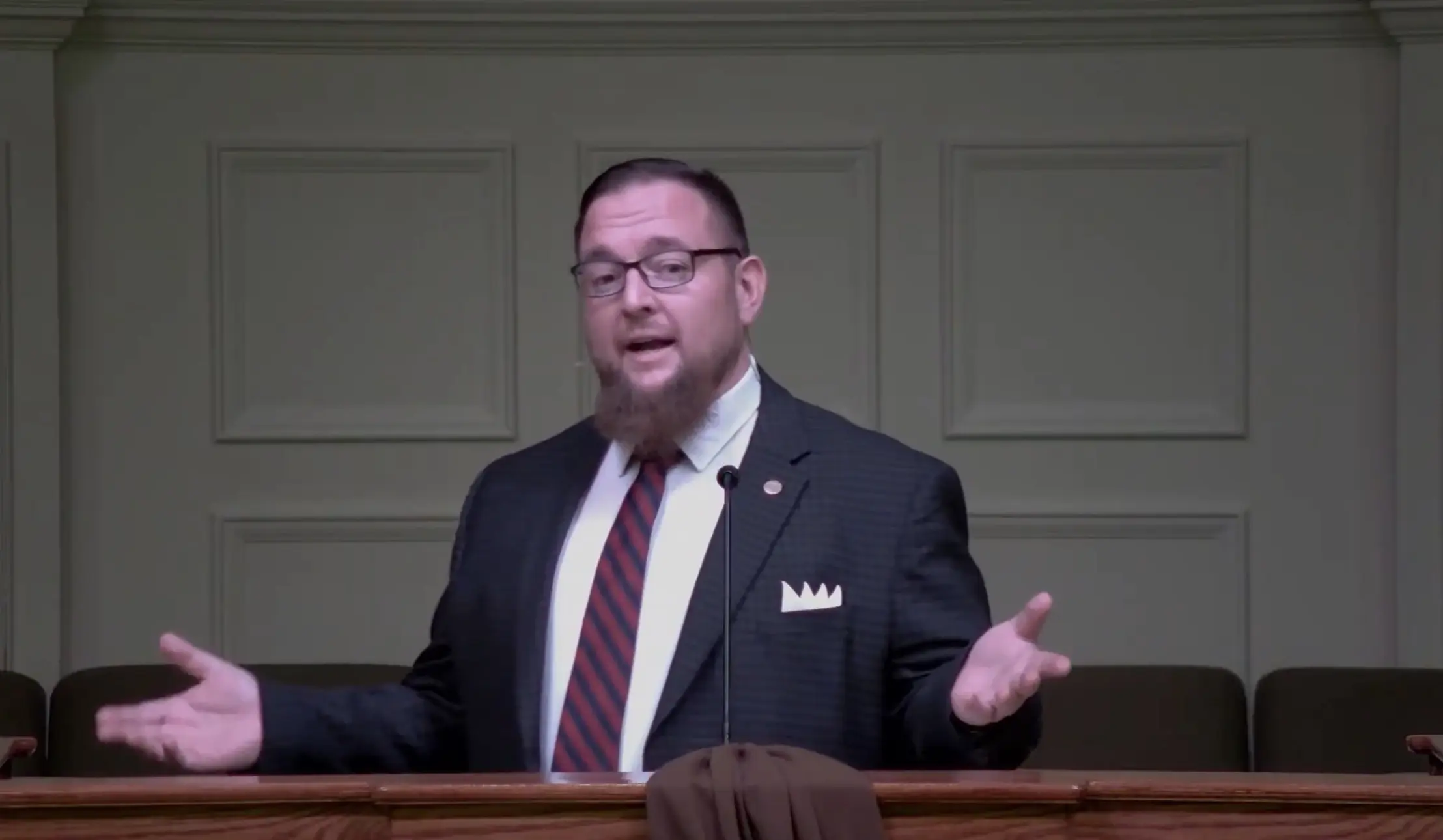
Video
“The Ordinances: The Lord’s Supper”
Pastor Ryan J. McKeen
04/26/2026
Audio
Transcript
Turn with me in your Bibles to Matthew 26. I love that song we just sang, and I love singing that song along with the Lord’s Supper. And that will be the focus of our time together this evening, the second ordinance, the Lord’s Supper. And I really appreciate the, that’s why I had Pastor Stephen read the entire section on the Lord’s Supper in the 1689 London Baptist Confession, and the lengthiness of it shows you that they were really addressing some problems that people had or people believed about the Lord’s Supper and still problems that still exist in false ideas or beliefs about the Lord’s Supper. So tonight we’re going to take a look at what the Bible says about what we do in taking the Lord’s Supper. But first we will read from The Lord Jesus’ institution of this ordinance, and that’s in Matthew 26, starting in verse 26, and I’ll read through verse 30. So please follow along in your copy of God’s word. Matthew 26, verses 26 through 30.
Now while they were eating, Jesus took some bread. And after a blessing, he broke it. And giving it to the disciples, he said, take, eat, this is my body. And when he had taken the cup and given thanks, he gave it to them, saying, drink from it, all of you, for this is my blood of the covenant, which is poured out for many for the forgiveness of sins. But I say to you, I will not drink of this fruit of the vine from now on until that day when I drink it new with you in my father’s kingdom.” And after singing a hymn, they went out to the Mount of Olives.
In our series on worship, we have come to the part of the series, as we started last week, where we focus on what we do in our worship services. We are beginning, first of all, with what Jesus commanded us to do in our worship. And we’re beginning with the ordinances.
And we talked about last week why we call them the ordinances and not sacraments. And we saw that while they’re ordinances that Jesus gave us that we are to obey, they in no way contribute to our salvation. That’s why they are a means of grace, not a means of salvation, as is a false idea in things like the Catholic Church, or even others who believe that doing these things contributes to the grace we’re given in salvation. And that’s just not true. And we look at those things last week as we began with the first ordinance of baptism. We looked at the biblical accounts of baptism and Jesus’ command to baptize disciples.
And now we come to the second ordinance, which is the Lord’s Supper. And there are actually a few names for this ordinance that we use. Some we use multiple names and some names we don’t use. So I’d like to start by looking at those names. And the first one is the Lord’s Supper.
That’s what I’ve already used to call it this evening. And this name comes from Paul’s instructions in 1 Corinthians 11, where he says, in really rebuking them for taking the Lord’s Supper improperly, He says in verse 20 of 1 Corinthians 11, therefore when you meet together in the same place, it is not to eat the Lord’s supper. And that’s what he calls it. And so that’s where we get that name.
And really that name, the Lord’s supper, shows the Lord’s rule over it, his domain over this very ordinance. It is instituted by the Lord, as I just read in the account in Matthew. and what it is and what it means, and even the participants in it are determined and defined by the Lord himself. And those who do participate in the Lord’s Supper, we do so as his privileged people. This is a grace to us, it is a gift to us to remind us of what makes us who we are as the Lord’s people.
So the first name we use often is the Lord’s Supper. But another name we often use is communion. We call it communion sometimes, and this comes from Paul’s use in 1 Corinthians 10, where he says in 1 Corinthians 10.16, is not the cup of blessing which we bless a sharing in the blood of Christ. Is not the bread which we break a sharing in the body of Christ. So there, Paul specifically calls this ordinance a sharing. And that’s where the word communion comes from.
It is a sharing together in this ordinance as God’s people. So those who participate in the Lord’s Supper, in this fellowship, we are united together in Christ. In some higher church circles, they call it holy communion. But this is a communion together as God’s people in the Lord’s ordinance given to the church.
There is another name for this that we don’t use. It’s the name the Eucharist. And the reason we don’t use it is because that’s what the Catholics call it. And honestly, there’s nothing wrong with the name Eucharist because it comes from the Greek word Eucharista, which just means Thanksgiving. And the word Eucharist is used in all of the accounts of the Lord’s Supper because the Lord gives thanks for the elements used in the Lord’s Supper. So again, that’s where this name comes from. So the word itself, there’s nothing wrong with. But again, to separate from the ideas that come with what is typically practiced in the Eucharist, we just avoid that name altogether. So those are some of the different names for this one ordinance that has been given by the Lord Jesus. And really, that idea of thanksgiving is a good attitude to have as we approach the idea of this ordinance. We ought to be thankful.
We ought to be humbled and eternally grateful for what the Lord’s Supper represents. That’s what we will look at as we now look at the biblical instruction for this ordinance, for the Lord’s Supper. As we begin, we’ll start with really what the Lord’s Supper represents. Actually, we’ll start from the Old Testament, because the Old Testament sets the stage for what would come in Christ, in his sacrifice and propitiation for his people, and what the Lord’s Supper represents. Really, there’s a pretty strong link, and it’s pretty obvious, between the Lord’s Supper and the Passover, the Passover meal. Not only does Paul speak of Christ in 1 Corinthians 5, verse 7, as our Passover lamb, where he says, for Christ, our Passover lamb was sacrificed. But also think about the timing of the very first Lord’s Supper.
It was during the Jewish Passover and during the Festival of Unleavened Bread. And Jesus timed this meal as he was about to be crucified as a representation of a change that was coming. This was going to replace the Passover. They no longer had to observe the Passover year over year, and all of the sacrificial observances that they made. This was a shift in eras in God’s salvation plan, or dispensations, if you will. Something new was happening, and this was a sign that something was changing.
And while the Passover was the Jewish festival celebrating Israel’s release from captivity, the release from slavery in Egypt, and they did that to represent what God did in saving them, well, so too the Lord’s Supper. It represents the church’s foundational celebration of what Christ has done for us and releasing us from the captivity and slavery of sin. So you can see a lot of the imagery that are very similar in the association that’s made between the Lord’s Supper and the Passover. It also highlights Jesus’ substitutionary role. in the Passover.
They recognized that the Lamb was slaughtered to save the life of the firstborn of Israel. And they were to obey the Lord’s instructions in doing that and putting the blood over their doorways. And if they did, the Lord would pass over and spare their firstborn. But the Lamb stood in as the substitute.
Well, in the same way, as we recognize in the Lord’s Supper, Jesus stood in as our substitute, and the elements that we partake of represent what he gave in our place. So as we take the elements of the bread and the juice that represent the body and blood of the Lord, not only should we think about that the Lord gave his body and blood, we ought to think about that he gave it in my place. And as we take these elements, we ought to remember this ought to be my flesh and my blood that need to be given to pay for my sin. But he is my substitute. He took that for me.
And the reason why that we can celebrate through a meal like the Passover, not the Passover, like the Lord’s Supper, is because of that very substitute. So that’s a lot of the imagery that we see that represents a change from that Passover of the Old Testament to the new covenant in Christ’s blood. And that’s another image that we see in the Old Testament.
When the Lord made a covenant, he made it in a sacrifice of blood. And Jesus says in the passage I just read in Matthew 26, he says, for this is my blood of the covenant, which is poured out for many for the forgiveness of sins. Again, this signifies a change in the working of God in the covenant that he made. In the Old Testament, when God made a covenant, he made it in blood. Turn to Exodus 24 with me. Exodus 24 speaks of the Mosaic covenant, the covenant God made with the people of Israel there in the wilderness. Turn to Exodus 24, starting in verse 3. This is what Moses records for us here in Exodus.
It says, then Moses came and recounted to all the people all the words of Yahweh and all the judgments. And all the people answered with one voice and said, all the words which Yahweh has spoken we will do. So he’s given them the commandments of God, the 10 commandments and then the law that was given with them. And they agree that they will do it. They are making that covenant agreement. They are entering in this covenant with God. It says, and Moses wrote down all the words of Yahweh.
Then he arose early in the morning and built an altar at the foot of the mountain with 12 pillars for the 12 tribes of Israel. And he sent young men of the sons of Israel and they offered burnt offerings and sacrificed young bulls as peace offerings to Yahweh. And Moses took half of the blood and put it in basins, and the other half of the blood he sprinkled on the altar. And he took the book of the covenant and read it in the hearing of the people. And they said, all that Yahweh has spoken we will do, and we will be obedient. So Moses took the blood and sprinkled it on the people and said, behold the blood of the covenant, which Yahweh has cut with you in accordance with all these words.
When God makes a covenant, He seals it in blood. He shows the cost to make this covenant. And through this symbolic act of slaughtering all of these animals and pouring out the blood, the Israelites were bound to this covenant, to their God. And by using the expression, my blood of the covenant, Jesus is saying that his own sacrificial blood binds God’s people to himself. in this new covenant.
And by partaking of that element, we signify that we are part of this new covenant Jesus made with the people of God. And so all of these pictures that are represented in the Lord’s Supper, they show us that not only were these things prefigured in the Old Testament, But God has done something new. God has done something new in his salvation plan with his people. And lastly, as far as Old Testament connections go, Matthew links the Lord’s Supper with the Old Testament sin offerings. Because as I read in that verse, Matthew 26, 28, this is the blood of the covenant, which is poured out for many for the forgiveness of sins. So Jesus himself is presented as the sin offering, just as in the old covenant sacrificial system.
So by partaking of the cup that represents his blood, the blood of the new covenant, we celebrate the forgiveness given to us by the Lamb of God, who poured out his blood for our sin. So that is really some Old Testament imagery that points us to the significance of this ordinance. So now let’s look at some New Testament instruction on what we are doing when we obey this ordinance of the Lord’s Supper. And really, I want to look at three principles that we need to remember, or three principles about the Lord’s Supper that the New Testament shows us.
And as we’ve already kind of mentioned, number one, that the Lord’s Supper does signify a new covenant, a new way of working with his people. Turn to Luke chapter 22. This is Luke’s account of Jesus instituting the Lord’s Supper. Luke 22, beginning in verse 14. And when the hour had come, He reclined at the table and the apostles with him.
And he said to them, I have earnestly desired to eat this Passover with you before I suffer. For I say to you, I shall never again eat it until it is fulfilled in the kingdom of God. And when he had taken a cup, he had given thanks and he said, take this and share it among yourselves. For I say to you, I will not drink of the fruit of the vine from now on until the kingdom of God comes. And when he had taken some bread and given thanks, he broke it and he gave it to them, saying, This is my body, which is given for you. Do this in remembrance of me. And in the same way, he took the cup after they had eaten, saying, This cup which is poured out for you is the new covenant in my blood.
God had done something new with his chosen people. This is a new covenant. It is not like the old covenant. And we see this explained in the book of Hebrews. And I want to read this passage in Hebrews because it really emphasizes that there’s a difference here, that this is not like the old covenant.
And many of the wrong ideas of the Lord’s Supper and the ordinances in general, what they end up doing is re-sacrificing the Lord Jesus. In fact, the Catholic picture of the mass, as they call it, as the confession pointed out for us, is really a re-sacrificing of the Lord Jesus every time it is performed. But Hebrews chapter 10 has no such idea in mind. There is no such thing as a re-sacrificing of the Lord Jesus.
So turn to Hebrews 10 with me. Hebrews chapter 10, we’ll start right in verse 1 of Hebrews 10. It says this, for the law, it starts off with the old covenant and what is represented in the instructions given to Israel there in that old covenant. This is for the law.
Since it has only a shadow of the good things to come, and not the very form of the things, can never, by the same sacrifices which they offer continually, year by year, make perfect those who draw near. Otherwise, they would not have ceased to be offered, because the worshipers, having once been cleansed, would no longer have consciousness of sins. But in those sacrifices, there is a reminder of sins year by year, for it is impossible for the blood of bulls and goats to take away sins.
When he comes into the world, he says, sacrifice an offering you have not desired, but a body you have prepared for me. In burnt offerings and sacrifices for sin, you have taken no pleasure. Therefore, or sorry, then I said, behold, I have come in the scroll of the book, it is written of me to do your will, oh God. After saying, sacrifices and offerings and burnt offerings and sacrifices for sin you have not desired, nor have you taken pleasure in, which are offered according to the law. And this is all talking about these sacrifices were a picture of the things to come. They were a shadow. They were pointing to this. But then he goes on. Behold, I have come to do your will. He takes away the first in order to establish the second.
By this will we have been sanctified through the offering of the body of Jesus Christ once for all. And every priest stands daily ministering and offering time after time the same sacrifices which can never take away sins. But he, having offered one sacrifice for sins for all time, sat down at the right hand of God, waiting for that time until his enemies are put as a footstool under his feet. For by one offering, he has perfected for all time those who are being sanctified.
And the Holy Spirit also testifies to us, for after, saying, this is the covenant that I will make with them. After those days, says the Lord, I will put my laws upon their heart, and on their mind I will write them. Then he says, and their sins and their lawless deeds I will remember no more. Now, where there is forgiveness of these things, there is no longer any offering for sin.
So one thing to make incredibly clear, as we think about the Lord’s Supper, and we think about how many people today have a wrong idea of it, it is not a sacrifice for our sins. That has been done. It was a once for all sacrifice. What we do in the Lord’s Supper is look back and remember the sacrifice that was made.
So any idea that this is part of our salvation because it repays for the sins that we’ve committed is completely false. And it goes completely against what scripture clearly says. In the old covenant, yes, Israel had to make continual sacrifices for sins because the blood of bulls and goats did not take sins away. But now in the new covenant, Jesus, the one that those sacrifices pointed to, did come and he did take away those sins once for all in his sacrifice.
So again, the Lord’s Supper is not a re-sacrificing of the Lord Jesus to pay for our sin again. It is a remembering of his once for all sacrifice. And just as Israel remembered their deliverance from slavery in Egypt, we remember our deliverance from sin in the meal that we celebrate in the Lord’s Supper. So the New Covenant people of God, whenever we come to the table, we remember these things, and that’s what the Lord’s Supper is. It is, number one, a new covenant. Secondly, the second thing we need to understand about the Lord’s Supper is that it is a real communion with and worship of Jesus Christ. It is a real communion with him.
So while there are some who overemphasize or over-signify what is happening in the Lord’s Supper, there’s also a danger of under-emphasizing. representing what is happening in the Lord’s Supper. Again, I read earlier about 1 Corinthians chapter 10, verse 16. Is not the cup of blessing which we bless a sharing in the blood of Christ? Is not the bread which we break a sharing in the body of Christ?
It is a real sharing, a real communion. It is at the table of the Lord’s Supper that we celebrate our common union or communion with Jesus Christ. There is a real communion here. It’s a real sharing in the blood of Christ and the body of Christ. Again, a lot of what we’ll do tonight is countering false ideas.
So, not in the sense of this communion, not in the sense of the Roman Catholic doctrine of transubstantiation. where they teach that the bread becomes the actual body of Christ when you take it. And the wine or the fruit of the vine, the juice that you take, becomes the blood of Christ when you take it.
And that’s just not true. It is a wrong understanding of this. There is nothing magical or mystical that happens to the elements themselves when you take them. And again, we talked about this a couple months ago when we were in John 6, because that’s where that false understanding comes from.
It’s a misunderstanding of the metaphor Jesus is talking about, about eating his flesh and drinking his blood. So that is a wrong idea of what is happening in communion. But it’s also not the really just modified view of that called consubstantiation, which is a traditional Lutheran view. Martin Luther and some other reformers believed that Christ is present, and this is how they said it, in, with, and under the bread and wine during communion, but that the substance of the bread and wine remains unchanged, which seems to me to be a distinction without a difference. It’s not really as flesh and blood, but it’s kind of the same thing. It’s in, under, and around the elements when you take it.
And again, that’s just language that I’m not comfortable with when it comes to what we’re doing in the Lord’s Supper. But at the same time, all many people, especially in our church circles, more Baptist circles, simply call it a memorial of the death of Christ. And it’s true, it is that. It is a memorial, and that’s what the Bible calls it. In 1 Corinthians 11. Verse 25, it says, in the same way he took the cup also after supper saying, this cup is the new covenant in my blood. Do this as often as you drink it in remembrance of me. So it is a memorial. We do it in remembrance of him. But while it is a memorial, it’s more than that. It’s more than just simply a memorial. It is a real communion of the people of Christ with Christ himself. There is a real spiritual benefit to the Lord’s Supper. Again, that 1 Corinthians 10 passage.
Is not the cup of blessing which we bless a sharing in the blood of Christ? Is not the bread which we break a sharing in the body of Christ? Since there is one bread, we who are many are one body, for we all partake of the one bread. The Lord’s Supper is the reminder of the cross. where we all are needy sinners at the foot of the cross, and we’re all united in our need for Him. We’re all on level ground in our need for a Savior. No one of us needs a Savior any less than the other one. And this is what identifies and symbolizes our oneness in the body of Christ. We all need a Savior, and He is our one Savior. And so at the cross, we are all equally in need of his mercy and grace, and we’re all equally recipients of that salvation.
So while we come to the Lord’s Supper to remember his death for us, we also come to the Lord’s Supper to commune with him, to commune with each other in sweet fellowship in Christ. He gathers his people and hears their praise when we are in obedience to him doing what he told us to. And so yes, we are actually communing together with Christ. As Ephesians says, there is one Lord, one faith, one baptism, one body of Christ, and we have one spirit.
And this is where we celebrate that, at the Lord’s Supper. This is why it is a means of grace. It communicates that grace to us. It is a gift from God to remind us of what we have in Him. I liked how the London Baptist Confession said it in the seventh paragraph that he read of chapter 30. It says this, worthy recipients who outwardly partake of the visible elements in this ordinance also by faith inwardly receive and feed on Christ.
We do it by faith. It is faith. We feed on Christ crucified and all the benefits of his death. They do so really and truly, yet not physically and bodily, but spiritually. The body and blood of Christ are not present bodily or physically in the ordinance, but spiritually to the faith of believers.
The ordinance strengthens our faith because it reminds us why we are who we are. It reminds us what it cost to make us his people. It benefits us spiritually by faith. Again, the ordinance itself or the elements that we partake do not contribute to our salvation in any way. And we are not actually partaking of the body and blood of the Lord in a way that impacts our physical or spiritual standing before God.
But it’s more than just a memorial. It is that. But if it was just a memorial that we were to go through the motions for as a ritual, that would be no different than the way that Israel viewed the old covenant rituals. Going through the motions and not actually spiritually benefiting from them. This is a means of grace and it does communicate to us the true union that we have in him because of what he has done.
And then thirdly and finally, The Lord’s Supper is for the Lord’s people. In 1 Corinthians 11 verse 26, it says, for as often as you eat this bread and drink this cup, you proclaim the death of the Lord until he comes. The Lord’s Supper is both a remembrance, but it’s also a proclamation of the death of the Lord. But not only that, it’s an anticipation. Because it’s proclaiming the death of the Lord until he comes. And all of those things, the remembering, the proclaiming, and the anticipating the return of the Lord, that’s the purpose of this. Only the Lord’s people do that. Only the Lord’s people want to remember his death. Only the Lord’s people proclaim his death. And only the Lord’s people anticipate his return.
So that itself clarifies for us who it is this is for. The Lord’s Supper is for the Lord’s people. It should be treated as an occasion for both solemn, serious remembrance, but also as a celebration. This is what makes us who we are. This is why we anticipate the return of the Lord, and because it is a A set apart ordinance given to us by Christ. Everyone who participates in it ought to take it seriously.
That’s what the instructions in 1 Corinthians tell us. Turn to 1 Corinthians chapter 11. This is the passage that I typically read from when we do the Lord’s Supper here on Sunday mornings. We’ll read through Paul’s instructions on how to take it. and then his warning on how it’s been taken improperly. 1 Corinthians 11, starting in verse 23.
It says, For I received from the Lord that which I also delivered to you, that the Lord Jesus, in the night in which he was being betrayed, took bread, and being given thanks, he broke it, and he said, This is my body, which is for you. Do this in remembrance of me. In the same way, he took the cup also after supper, saying, this cup is the new covenant in my blood. Do this as often as you drink it in remembrance of me. For as often as you eat this bread and drink the cup, you proclaim the death of the Lord until he comes.
Therefore, whoever eats the bread or drinks the cup of the Lord in an unworthy manner shall be guilty of the body and the blood of the Lord. But a man must test himself. And in so doing, he is to eat the bread and drink the cup. For he who eats and drinks, eats and drinks judgment to himself, if he does not judge the body rightly. For this reason, many among you are weak and sick, and a number sleep.
But if we judged ourselves rightly, we would not be judged. But when we are judged, we are disciplined by the Lord, so that we will not be condemned along with the world. These are important instructions, but they can sometimes be misunderstood. These instructions should not scare us away from the table. They should help us to understand rightly who it’s for. Because Paul continues to say, what will happen if this is taken improperly?
And it’s being guilty of the body and blood of the Lord, being judged by God. Who is it that is guilty of the body and blood of the Lord? Who is it that is judged by God? It’s unbelievers. The warning here is make sure you’re a believer and make sure you’re living like a believer.
Make sure your life shows you’re a believer before you come to the table. And so we ought to examine our hearts and confess our sins before God as we come to the table because that’s what believers do. And if we have an unresolved conflict with another believer, we ought to go and get that right as soon as possible.
Jesus gives that instruction in Matthew 5. He’s talking about the worship rituals in the temple there, but he says, therefore, if you are presenting your offering at the altar and there, remember, your brother has something against you, leave your offering before the altar and go. First be reconciled to your brother and then come present your offering. The same principle holds true with the Lord’s Supper.
If you have an unresolved sin issue in your life with another believer, go get that right. Go get that right before you come to the table because that’s what Christians do. So it is true that we ought to address and repent of any unresolved sin in our life.
But again, don’t let this warning scare you away from the Lord’s Supper. Because we ought to remember that the Lord’s Supper is supposed to remind us that we’re forgiven sinners. We are forgiven sinners. And these instructions to examine ourselves don’t mean that we can’t take the Lord’s Supper if we’re a sinner, or we can’t take the Lord’s Supper if I’ve sinned within the last so many hours. Confess our sins, and He is faithful and just to forgive us our sins.
That’s why we must examine ourselves, because that’s what believers do, is it is most importantly The Lord’s Supper is a call to repentance. To be invited to the table is an incredible blessing and grace from God. But the cost was unfathomable to us. We need to remember how serious this is. And we shouldn’t come to the table with sin in our life that he died for. It’s a call to repentance.
And after we come to the table having repented of sin and we encounter Jesus Christ and his offering of his own body and blood for our sins, we ought to leave with praise on our lips for him because of the incredible cost it was to save us. Because all believers are welcome to the table. The Lord’s Supper is for the Lord’s people. But this also means that unbelievers are not welcomed to the table. There are typically three views on the Lord’s Supper.
There’s closed, fenced, or close, and open. Closed means you have to be a member of that particular church before you’re allowed to take communion. Fenced or close means you must be a believer of like faith. You don’t have to be a member of that church, but as long as you are a believer, you’re welcome to the table. And then open is anybody can come, anybody can partake.
And the Lord’s Supper, again, is for the community of Christ’s people. So this is a family meal. And while we are always to welcome outsiders to come and to observe our worship, and to evangelize them and share the gospel with them, and they ought to come and sit under the preaching of the gospel. But when it comes to participating in communion, it’s for the Christian community.
And we’ve missed the point of the ordinance if unbelievers don’t understand that they’re on the outside looking in, that they are invited to the family But they’re not invited to the table unless they’re in the family. And Paul’s warning is that people who eat of the bread and drink of the cup unworthily bring on themselves the wrath of God. And the wrath of God is for unbelievers. So his warning is against those who are unbelievers, living in unrepentant sin, and still coming to the table. So his warning primarily means make sure you’re a believer before you partake of the supper. Believers are regenerate, baptized, and repenting people. And once again, I like how the London Baptist Confession says that in the last section that Pastor Stephen read earlier, section eight of chapter 30, says this.
All ignorant and ungodly people are unfit to enjoy communion with Christ. and are thus unworthy of the Lord’s table. There you go. All ignorant and ungodly people are unfit. As long as they remain in this condition, they cannot partake of the holy mysteries or be admitted to the Lord’s table without committing a great sin against Christ. All those who receive the supper unworthily are guilty of the body and blood of the Lord, eating and drinking judgment on themselves. We must fence the table.
We must make sure that it is believers invited to the table. But we do that with grace, and we do that with longing and hoping for the day when they do come and join us because they’re believers, and they can come participate freely with us. But the requirements for the Lord’s Supper is that you are a believer, and you are not living in unrepentant sin. And as we saw when we studied baptism last week, a biblical Christian is a baptized believer. So you should also be baptized before you come to the table because that’s what an obedient Christian does. And celebrating communion with each other and with the Lord Jesus Christ, we do have one baptism.
And that’s another thing that we celebrate is our unity together. And so that is the biblical instruction on the Lord’s Supper. There’s other things that come into play as far as how we take it. Other things like how often should we observe the Lord’s Supper?
And those things are left up to individual churches. There is no command that you must take it weekly or you must take it monthly. There are some traditions, like the Dutch Reform tradition, that has a communion season where they do it, it’s really once a year, but they have a series of three or four Sundays where they preach about it and then make it a big, really celebration service where they take communion together once a year.
So there’s different opinions on how that should be taken, and that’s really left up to individual churches. And also, the issue of whether or not a church uses real wine or grape juice. Again, that’s left up to the conscience of the different churches. There’s no command one way or the other. Jesus does say the fruit of the vine in Matthew 26, and he’s pretty vague about that. It’s not necessarily wine in that verse, but it’s up to interpretation, and churches are free to pursue their own convictions on that. But most importantly, what we’ve seen tonight regarding the Lord’s Supper, the three things I want to make sure we understand. about the Lord’s Supper is, first of all, the Lord’s Supper signifies the new covenant. That there’s something new here.
This is the new covenant in his blood. And as we read about the new covenant, it’s a once for all covenant. The sacrifice was once for all. This is not a re-sacrificing of the Lord Jesus every time we come to the table. It’s a once for all, new covenant ordinance.
Secondly, the Lord’s Supper is a real communion. with and worship of Jesus Christ. It is a memorial. We do this in remembrance of him, but it’s also a spiritual blessing. It really is a grace of God and a reminder of the unity we have together because of the sacrifice of the flesh and blood of Jesus Christ.
And then lastly, thirdly, the Lord’s Supper is for the Lord’s people. Like baptism, the Lord’s Supper is a supreme act of worship. It declares the supreme importance and worthiness of our Lord and Savior, Jesus Christ. And it is commanded to be done until the Lord returns and brings us to himself, where then we will have face-to-face communion with him for eternity.
So let’s stand and close in a word of prayer this evening. Our God in heaven, we thank you. We thank you for the ordinance of the Lord’s Supper, for the reminder that it is of what it costs to pay for our sins, to buy our salvation, and to make us your people. And Lord, I pray that as we consider these things that we’ve talked about tonight, that we would take seriously this ordinance of the Lord’s Supper, that we would understand what it means, understand what it cost, and understand the benefit that we have in Christ because of the shed body and blood of our Lord. We thank you for who you are, and we thank you for who you have called us to be in Christ. We pray all this in his precious name, amen.