
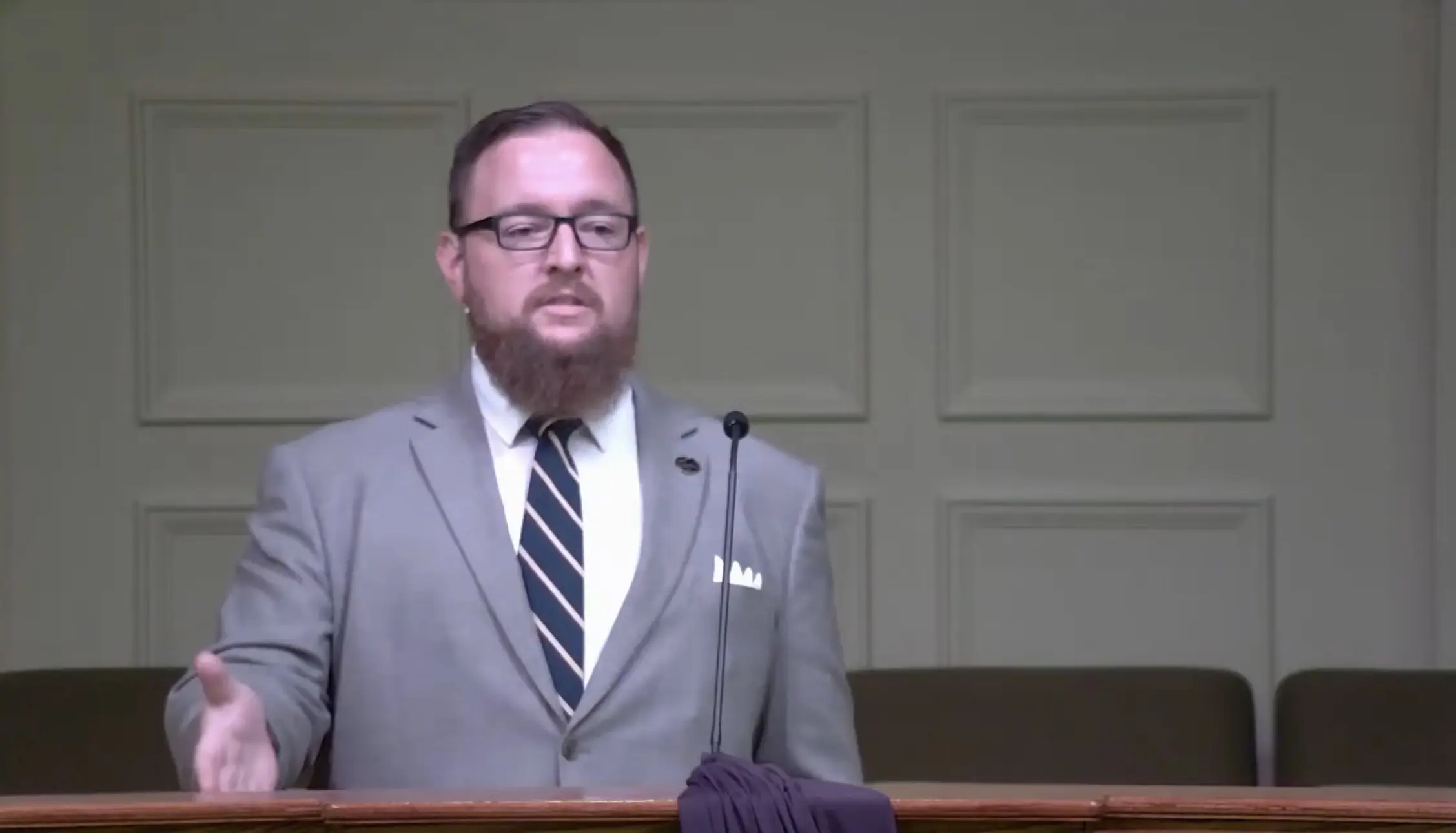
Video
“Not Even His Brothers”
John 7:1-13
Pastor Ryan J. McKeen
03/29/2026
Audio
Transcript
Turn with me in your Bibles to John chapter 7.
We have come now in our study of John’s Gospel to the seventh chapter. As we have seen, one of the themes John has been tracing for us in this Gospel is the response to who Jesus is. And we are reminded of that even today as we think of Palm Sunday and the triumphal entry of Jesus and what a time of celebration and elation that was. For people, crowds, to be laying down their garments and praising Him as the King. But oh what a difference a few days makes. Because only days later, He would be on trial, and mocked, and beaten, and crucified.
And what we see in John’s gospel is the importance and the focus on the response to who He is. That was the focus at the end of John chapter 6. As Jesus had preached in the synagogue there in Capernaum, and John takes the time to explain to us the responses that Jesus saw to his preaching, to his revelation of who he was.
We saw that the crowds in the synagogue, the thousands of people that had been following him for the last few days, found his words difficult to accept, so they left. And then last week, we saw the response of belief from the 12. who stayed, and we saw Peter say, Lord, to whom shall we go?
You have the words of eternal life. And we have believed and have come to know that you are the Holy One of God. And again, that is what we continue to see over and over is these two responses to Jesus, rejection and belief. And we’ll continue to see that as we come now to chapter seven.
And what we also see is that the message and ministry of Jesus here was no longer a secret. While he began in the wilderness with John the Baptist and was relatively unknown at first, that obscurity that he had had now vanished. And he has become very well known. And now many of those around him had become suspicious of Jesus. In fact, as this scene here at the opening of John chapter 7 shows us, this suspicion had even spread to those who were very closest to Jesus. And the display of this suspicion was not just background information in John’s gospel.
It is revealing the point that you must have a response to who Jesus is. Again, that is why John wrote this gospel. We see in chapter 20 verse 31 that these things have been written so that you may believe that Jesus is the Christ, the Son of God, and that believing you will have life in his name. You will have a response to who Jesus is. Will it be belief or rejection?
And as John continues to show us, the more that the light shines, the more the darkness is revealed. But the good news for us, and as we’ll see today for Jesus’ brothers, is that we’re not left on our own in this. Because if we were, there would only be one response to him. We would all reject him. Even his own brothers who knew him best, initially they reject him.
But as Jesus showed us in chapter six, he is sovereign. He is sovereign over our souls. We saw Jesus say in John chapter six, verse 70, did I not choose you, the 12, and yet one of you is a devil? He knew because He chose them. And praise God that He did because no one can come to Him unless the Father who sent Him draws us.
And that’s what we see at the beginning of chapter 7. What we see is an entirely different setting. Chapter 6, we were left at the synagogue in Capernaum. And everyone but the 12 had abandoned him. And now, chapters seven and eight change the setting to this feast of booths in Jerusalem.
The very first verses here tell us of the preparation to go up to this feast, and the remainder tell us of what happens when Jesus arrives there. And again, we see the skepticism. This time, beginning with those who knew Jesus the best. So what we’ll see in our text this morning, we’ll cover verses 1 through 13 of John chapter 7.
And what we see here is the ridicule that Jesus faced from his brothers. The ridicule of the brothers. Then we see the response of Jesus. And then once they come to this feast, the reluctance of the crowds to believe in who he truly is. So allow me to read John chapter seven, verses one through 13 this morning. This is the word of the Lord.
And after these things, Jesus was walking in Galilee, for he was unwilling to walk in Judea because the Jews were seeking to kill him. Now the feast of the Jews, the feast of Booths was near. Therefore his brother said to him, leave here and go into Judea so that your disciples may also see your works which you are doing. For no one does anything in secret when he himself seeks to be known openly. If you do these things, show yourself publicly to the crowd. For not even his brothers were believing in him.
So Jesus said to them, my time is not yet here, but your time is always here. The world cannot hate you, but it hates me because I bear witness about it, that its deeds are evil. Go up to the feast yourselves. I am not yet going up to this feast because my time has not yet been fulfilled.
Having said these things to them, he stayed in Galilee. But when his brothers had gone up to the feast, then he himself also went up, not publicly, but as in secret. So the Jews were seeking him at the feast and saying, where is he? And there was much grumbling among the crowds concerning him. Some were saying he is a good man. Others were saying, no, on the contrary, he leads the crowds astray. Yet no one was speaking openly about him for fear of the Jews.
The first five verses of our text here, we see the preparation before this feast, before they go up to the feast, and what has come into our focus is the ridicule of Jesus’ own brothers. After John had written this gospel, Bible scholars divided the books of the Bible into chapters and verses. And they decided to make the division at this point here, at the transition of the setting. We’re at a different time and place than we were in chapter six.
The phrase after these things refers back to chapter six, which again, if you remember, took place at the time of the Passover, which is around April in our calendars, right about now. John chapter six verse four said, now the Passover, the feast of the Jews was near. So that tells us when chapter six took place. But chapter seven opens at the time of the Feast of Tabernacles, the Feast of Booths, which is in October. So some time had passed. There’s a gap of about six months between chapter six and chapter seven.
And John tells us nothing about what happened in that six months. other than it says that he spent the time walking in Galilee. The other Gospels fill in some of the details that happened during this time. We see in Matthew and Mark the time that he spends in Galilee before this feast, where he travels all over performing miracles, healing people, casting out demons.
This is when he fed the crowd of the 4,000. And he spent a lot of time teaching his disciples. Matthew records many different instances in this time period where Jesus is teaching the disciples specifically, telling them parables and the various ways that he taught them. Jesus spent only a few days with the crowds in chapter six, but he spends months discipling the 12, which ought to be instructive for us. We ought to spend our time making disciples, not worried about attracting crowds. Jesus made disciples.
And he spent six months walking around Galilee, but not Judea, because there was a price on his head in Judea. They were seeking to kill him. And we saw this back in chapter five, when he was in Judea. Chapter 5 verse 18 says, For this reason, therefore, the Jews were seeking all the more to kill him, because he not only was breaking the Sabbath, but calling God his own father, making himself equal with God. And this will be more and more of a present theme as the gospel goes forward. They continue to seek to kill him.
But it’s not as though Jesus was afraid or unwilling to die. That’s not why he hadn’t gone to Judea yet. We know the opposite is true. He came to die. That was why he came to die for sinners. But as we’ll see in a few verses here, he knew the schedule. He knew when this was supposed to take place. He knew that it was not yet time for him to die. So he stays in Galilee here with the 12. And verse two tells us the time that this was.
It says, now the feast of the Jews, the Feast of Booths was near. The Feast of Booths or Tabernacles was one of the most sacred Jewish holidays. It lasted seven days. And it was on the Jewish calendar from the 15th to the 21st of their month, Tishri, which is September to October on our calendars. And this feast was commanded by God. We find it in Leviticus chapter 23.
This was something they were to do to remember what God had done for them. And it was marked by different celebrations and parties for a whole week. So this was a crowded place at this time. And lots of people were there to celebrate. And this was a feast that all the Jewish males were required to attend.
So Jesus’ brothers assume that he’s ready to go up, that he soon would leave for Galilee and go into Judea. So verse three here mentions Jesus’ brothers, and these were Jesus’ brothers. They were his half-brothers, the children of Mary and Joseph. The word here is the word adelphos, which is the word for brother. These are not Jesus’ cousins. as Roman Catholic teaching would tell us. The Bible has a word for cousin and uses it, but not of these men. These are his brothers.
The passage I read earlier in the service links these brothers to Jesus’ mother, Mary. Matthew 12, 46, while he was still speaking to the crowds, behold, his mother and brothers were standing outside seeking to speak to him. These are his brothers, Mary’s children.
There’s absolutely no biblical evidence that Mary remained a virgin after the birth of Jesus. In fact, quite the opposite. She had several children. In fact, Matthew chapter 13 names them. Matthew chapter 13 verse 55 says, is this not the carpenter’s son, speaking of Jesus? Is not his mother called Mary and his brothers, James, Joseph, Simon, and Judas?
These are the brothers that John is speaking of here. And as we will see, they don’t yet believe. Not at this time, although they will come to believe in him. We see in Acts chapter one, there with the group that Jesus left. Acts 1.14, these all with one accord were continually devoting themselves to prayer along with the women and Mary, the mother of Jesus, and his brothers. They eventually believed. And two of his brothers, James and Judas, who becomes Jude, wrote letters in the New Testament. And James becomes the head of the Jerusalem church.
But here, in John 7, probably led by James, the brothers have something to say to Jesus. In verse 3, it says, “‘Therefore,’ his brother said to him, “‘Leave here and go into Judea, “‘so that your disciples also may see your works “‘which you are doing.
“‘For no one does anything in secret “‘when he himself seeks to be known openly. “‘If you do these things, “‘show yourself publicly to the world.’” There’s a tone to these words, and it makes it clear These brothers are ridiculing him, mocking him. They’re mocking him for what they think he is.
They tell him he should go from here and go show your disciples these things. The twelve are with him. These disciples that they’re referring to here, the ones that left, the ones that look to be their disciples but left him. These weren’t true disciples they were talking about here.
In verse four, for no one does anything in secret when he himself seeks to be known openly. They characterize Jesus as someone who’s seeking to be known openly. Come on, Jesus, we know you like the attention. Why don’t you go get some more attention and show yourself to the world?
It sounds like little brothers, doesn’t it? I have little brothers, and this is what they sound like. You can tell by their words that they don’t really understand who Jesus is yet. Remember, John the Baptist didn’t understand at first either until God showed it to him. That’s where these brothers are. They don’t get it yet.
They think Jesus just likes the attention and the crowds, and so they ridicule him and prod him to go to the feast and get more attention for yourself. And that’s why John follows up the words from these brothers in verse 5 with 4. They said this because not even his brothers were believing in him. John, make sure we don’t miss the point of what they’re saying here.
They said these things because they don’t believe yet. They don’t actually want Jesus to go out and get true followers yet. They’re sarcastically saying, why don’t you go get some more attention? They misunderstood because they don’t believe yet, which in itself seems hard to understand.
I mean, can you imagine growing up with a brother who never ever sinned? Who was perfect? And yet they still don’t believe in him. I mean, this may be the strongest argument for total depravity and the total inability of people to believe without God’s intervention. Not even his brothers were believing in him. If anybody should get it and believe, it’s these guys. Nobody spent more time with Jesus than these guys. They grew up with him. For 33 years, they’d seen him never sin, and not even his brothers were believing in him yet.
And that’s the first division we see in this text is the ridicule of his brothers. But next we see the response of Jesus. Verse six, Jesus said to them, my time is not yet here, but your time is always here. Jesus calmly and gently responds with the truth.
It wasn’t his time yet. Oh, he would reveal himself to the world. Make no mistake about that. But not yet. Jesus knew the schedule. And he knew the divine timeline. He knew that it was not yet time to reveal these things. And he would not allow his brother’s skepticism and ridicule to dictate his actions. He’s not here to do their will. His actions, what he did and when he did them, were determined by the will of God.
If you remember, back in chapter 2, Jesus responded the same way to his mother. When Mary comes to him and tells him to fix the problem, and Jesus says in John chapter 2 verse 4, woman, what have I to do with you? My hour has not yet come. Jesus there also rejected the pressure from his family to reveal himself before his time had come.
Jesus always operated on God’s timetable. We see this in Galatians chapter 4, verse 4. When the fullness of time came, God sent forth his Son. This was no accident. God had a plan, and Jesus knew the plan, and he followed the plan. He wasn’t going to change that here for his brothers. He tells them, but your time is always here. Jesus had a different purpose and mission than they did.
As one commenter said, this could be translated, for you, any time is right. You can go up any time you want. When you go up, doesn’t matter. It’s not my time yet, but feel free to go up to the feast yourself. That’s why he says in verse eight, go up to the feast yourselves.
I am not yet going up to this feast because my time has not yet been fulfilled. He has a different mission. He has a different purpose. They would understand that one day, but it’s clear that they don’t yet. In verse 7, Jesus explains why he can’t go up yet.
He says, the world cannot hate you, but it hates me because I bear witness about it. that its deeds are evil.” These are very serious and scary words. The world cannot hate you. The world hates him. The world wants to kill him. And if he went to this feast publicly like they said, he would be killed before it was his time. But He knows, and He’s in complete control. Unlike Him, they would face no hatred in Jerusalem. The world could not hate them, because they were part of the world. They were not His yet. They would have no reason to hate them. because they hate Christ and those who are his.
But as Jesus reminds his brothers, the world hates me because I bear witness about it, that its deeds are evil. Because the world and its system is controlled by Satan, their actions are evil. And when Jesus and his followers, us, When we bear witness about the world and the evil that is in the world, they don’t like to hear that. The world hates it when light is shined on its darkness. The world hates Him and those who are His.
That’s why Jesus tells us in chapter 15, if the world hates you, Know that it hated me before it hated you. If the world hates you, don’t think you’re doing something wrong. Now, you might be. That might be the reason for their hate. But if they hate you because you’re like him, don’t be surprised. The world hated him first. They want to kill him. which is why Jesus says here, you can go up. The world doesn’t hate you, but I can’t go up yet, not in the way that you’re telling me to.
So in verse nine, it says, having said these things to them, he stayed in Galilee. They all went up, but he stayed behind. He didn’t say that he’s not going to attend the feast at all, but he wasn’t going to go in the way that they expected him to. He wouldn’t allow the Jewish leaders, the world, to take his life yet, because his time had not yet come.
When Jesus does lay down his life, it’d be at the very moment that God determines. But this is the response of Jesus. The response to the ridicule of his brothers trying to pressure him to go up to this feast. It’s not my time yet. That is the response of Jesus. Then we see, at the feast, the reluctance of the crowds to believe in him. You see in verse 10, but when his brothers had gone up to the feast, which they should have, they were Jewish men, they were supposed to obey and go to the feast.
Then he himself also went up, not publicly, but in secret. When the time was right, Jesus did go. And he went to the feast in the way that he determined, not the way they wanted. It wasn’t publicly, like his brothers thought that he wanted. Oh, you want more attention? Why don’t you go up publicly and show everybody again? But he went up in secret.
Later, as we’ll see in verse 14, he comes in the middle of the feast, as things are already going on. So a lot of people wouldn’t have noticed him. They would have been busy with other things, other activities, the parties going on at this feast. And he wouldn’t draw the negative attention that could get him killed. But while he’s not yet at the feast, in verse 11, meanwhile, the Jews were seeking him at the feast and saying, where is he? Jesus was right. They were waiting for him. They were looking for him. They knew he would have to come to the feast. Where is he?
The phrase the Jews here doesn’t just refer to any group of Jewish people. It’s talking specifically about those Jewish leaders that were the opposition to Jesus. When John uses that phrase, that’s who he’s always talking about. The scribes and Pharisees and those ones who hated him. These specific Jews that were seeking to kill Jesus for the threat that he was to them and their system. Their power, their authority. And here, as Jesus said they would be, they’re looking for him. They’re waiting for him. And these Jews were not the only ones that had Jesus on their minds.
Because verse 12 goes on, there was much grumbling among the crowds concerning him. What else is new, right? The crowds are always grumbling about Jesus. Some were saying, he is a good man. Others were saying, no. On the contrary. He leads the crowds astray, yet no one was speaking openly about Him for fear of the Jews, the Jews who were looking for Him. So we see really two perspectives of Jesus in this crowd. Some say He was a good man.
He’s a pretty good guy. I don’t know what everyone’s so upset about. He’s pretty nice. I like him, he’s a good guy.” Others said, no, he’s a bad guy. He’s a bad man who leads people astray. And none of them are believers. None of them are saying who he truly is. They’re both wrong. Because he’s not just a good man. He is the Christ, the Son of God. He is God in the flesh, as Peter had just correctly said the chapter before. We have believed and have come to know that you are the Holy One of God.
Nobody was saying that, and they certainly weren’t going to say that out loud because they feared the Jews, the Jews who were seeking to kill him. Just like the parents of the blind man in the upcoming chapter, chapter nine, when the Jews, these same ones, are seeking to find out who would dare to heal somebody who was blind.
They ask this man’s parents in John chapter nine, verse 22, and it says his parents said this because they were afraid of the Jews. His parents said, you go ask him yourself. We’re not going to tell you. Don’t ask us, we don’t want anything to do with this guy.
His parents said this because they were afraid of the Jews. For the Jews had already agreed that if anyone confessed him to be the Christ, he was to be put out of the synagogue. In fact, this is another theme that comes up, as we see the responses of people To Jesus, one of the responses that we’ll continue to see is fear.
People who seem to believe, at least they acknowledge the facts, but they’re not going to say anything about it. Don’t tell anybody. Don’t let anyone know that I think he’s right. In John chapter 12, verse 42, many even of the rulers believed in him. The Jewish rulers, the ones who were supposed to be public enemy number one, at least to Jesus, many of the rulers believed him. How could you not?
But because of the Pharisees, they were not confessing him for fear that they would be put out of the synagogue. They would lose their status. They would lose their social acceptability. They wouldn’t be popular anymore. Even the rulers believed in Him, but for fear of the Pharisees. They were not confessing Him. Because of fear of what others might do, they were not confessing Him. And by not confessing Him, yes, they avoided some conflict and some persecution, but they also missed out on something much greater.
Because the Bible tells us that if you confess with your mouth that Jesus is Lord and believe in your heart that God raised him from the dead, you will be saved. Not if you believe in your heart, but keep it quiet because you don’t want to let anybody know. If you confess with your mouth. For with the heart a person believes, leading to righteousness, and with the mouth he confesses, leading to salvation. With the mouth he confesses, leading to salvation. And Jesus warns us of those who refuse to confess him.
In Matthew chapter 10, verse 33, from some of the scariest words in all of Scripture. Whoever denies me before men, I will also deny him before my Father who is in heaven. For fear of the Jews, they were not confessing him. Oh no, what are the Jews going to do to us? What do the Jewish leave? They might kick us out of the synagogue. What will the Father do to you? I will also deny him before my Father who is in heaven.
So who do you say that Jesus is? Do you confess with your mouth that Jesus is Lord? Do you believe in your heart that God raised him from the dead? Do people know that? Do you confess him? If we talk to your coworkers, your friends, your neighbors, what would they say? Do you confess him? Do they know?
Do you confess like Thomas does later on, my Lord and my God? I don’t care if they hate me. I don’t care if they think anything about me. Jesus is my Lord and my God. Are you like those that Jesus mentions in that next verse after Thomas’s confession, where he says, Blessed are, because you have seen me, have you believed? Blessed are those who have not seen me and believe. We have not seen him. Do you believe?
Or do you just simply say that he was a good man? The men’s study is going through C.S. Lewis’ book, Mere Christianity. There’s a famous line in that book, probably the most famous quote from the book, but C.S. Lewis lays it out for us. He says this, you must make your choice. Either this man, Jesus, was and is the son of God, or else a madman or something worse.
You can shut him up for a fool, you can spit at him and kill him as a demon, or you can fall at his feet and call him Lord and God. But let us not come with any patronizing nonsense about him being a great human teacher. He has not left that open to us. He did not intend to. You see, there’s two responses to Jesus. And he is a good man is not one of them.
It’s rejection or belief. It’s total submission to who he is. He is Lord and God. Or it’s rejection. He is not a madman seeking popularity like his brothers thought. And He is not just a good man, like some of the crowd thought. He is the God-man. He’s God in the flesh. He came for sinners who believe in Him. So who do you say that He is?
Let’s stand and close in a word of prayer this morning. Our God in heaven, we thank you for how clear you make it for us. How clear it is that there is only two responses to who you are. There’s rejection of belief. Lord, I pray if there is anyone here today who is still rejecting Christ, that you would soften their heart. and bring them to yourself. That if you are calling them, if they can hear your call, that you would continue to bring them to confession and belief in who He is. Lord, we thank you for sending your Son, even to be ridiculed, to be mocked, to be beaten, to be persecuted, to be crucified. for us, for those who believe and confess that Jesus Christ is Lord. God, we thank you, we praise you, and glorify you this morning. We pray this in Jesus’ precious name, amen.