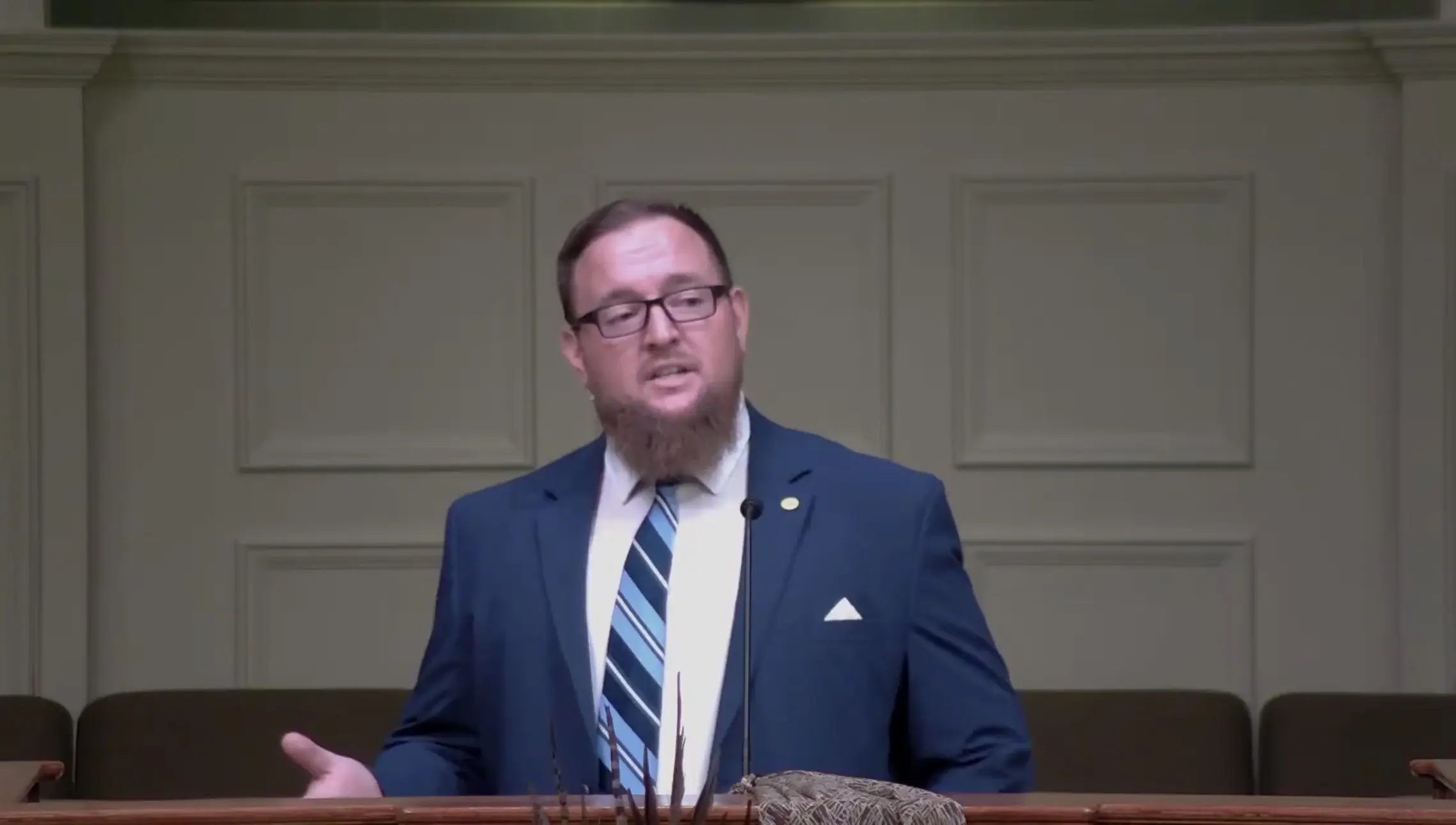

Video
“My Witness Is True”
John 8:13-20
Pastor Ryan J. McKeen
06/07/2026
Audio
Transcript
John chapter 8, this morning, we will be picking up in verse 13. And one of the main themes we’ve seen throughout the gospel of John, really the purpose of the gospel of John, is to bear witness, to bear witness to who Jesus is. As we have seen several times in John’s purpose statement, in John chapter 20, verse 31, this gospel was written, so that you may believe. that Jesus is the Christ, the Son of God, and that believing you may have life in his name. The purpose is belief. So the goal is convincing us to believe. And so the testimonies that John has provided all serve to bear witness, to bear witness to Jesus’ identity as the Christ, the Son of God.
And this began back in the prologue, the introduction to John’s gospel. There he says in chapter 1 verses 6 through 8, there was a man having been sent from God whose name was John, speaking of John the Baptist. He came as a witness, to bear witness about the light, so that all may believe through him. He was not the light, but he came to bear witness about the light. And then as soon as the prologue or introduction concludes in verse 18, verse 19 starts with, and this is the witness of John.
So the witnesses and testimonies begin. So this whole gospel is framed in a courtroom style setting. Here are the witnesses here to testify to us. The apostle John is the attorney and he calls different witnesses To bear witness to Jesus’ identity, that is what is on trial here. Who is this Jesus? Various witnesses are presented to convince us, the readers, of John’s case for who Jesus is.
And as is typical in courtroom proceedings, even today, when a case is being made convincingly, Several tactics are often used to try to change the effect that witnesses are having. Sometimes in criminal trials, they may try to intimidate witnesses or even jurors to try to sway the outcome because that witness is being too convincing. We’ve seen that take place already. As we saw back in chapter seven, verse 13, it said, no one was speaking openly about him for fear of the Jews. They were already using intimidation to try to silence the witness to who Jesus was. Or sometimes when a witness is especially convincing, often they will try to discredit the testimony being given, sometimes by attacking the character of the witness. We’ve already seen that happen too, several places, but most recently at the very end of chapter 7, verse 52. They answered him, are you also from Galilee? Search and see that no prophet comes from Galilee.”
They’re attacking the character of this witness. They try to sometimes attack the credibility of the witness, the credibility of his testimony. You can’t believe that. And that’s exactly what we see in our text this morning. In our passage this morning, we see the Jews attempt to discredit what Jesus is saying because of who he is and because of how he presents his testimony. And they try to do so not by proving that what he’s saying is false, but by trying to get his testimony thrown out because of a technicality.
We remember that what Jesus has been testifying to First, we saw back in chapter seven, verses 37 to 38, that on the last day, the great day of the feast, Jesus stood and cried out. So this is the testimony they’re directly trying to discredit, saying, if anyone is thirsty, let him come to me and drink.
He who believes in me, as the scripture said, from his innermost being will flow rivers of living water. And he followed up that testimony by adding, in the verse we covered last week, Chapter eight, verse 12, Jesus again spoke to them saying, I am the light of the world. He who follows me will never walk in the darkness, but will have the light of life. So that is his testimony. That is what he’s testifying here. And so following those claims to be the source of living water and to be the light of the world, we see the Jews respond and Jesus answers them.
In our text this morning, we see the Jews’ accusation, first of all, and then we’ll see Jesus’ answer, and lastly, Jesus’ assessment of them. So allow me to read our text for us again this morning. I’m gonna read verses 13 through 20 of John chapter eight. John chapter eight verses 13 through 20. This is the word of the Lord.
So the Pharisee said to him, you are bearing witness about yourself. Your witness is not true. Jesus answered and said to them, even if I bear witness about myself, my witness is true. For I know where I came from and where I am going. But you do not know where I come from or where I am going. You judge according to the flesh. I am not judging anyone. But even if I do judge, my judgment is true, for I am not alone in it, but I and the Father who sent me. Even in your law it has been written that the witness of two men is true. I am he who bears witness about myself, and the Father who sent me bears witness about me. So they were saying to him, where is your father? Jesus answered, you know neither me nor my father. If you knew me, you would know my father also.
These words he spoke in the treasury as he was teaching in the temple, and no one seized him because his hour had not yet come. Again, as we saw in the very last verse, the preceding verse, Jesus makes an incredible claim, an apparently unbelievable claim to these Jews. He claimed to be the light of the world. And since God is spoken of throughout Scripture in terms of light, and since as we saw last time that this claim directly refers to the cloud in the desert leading the Israelites, the provision of God, the presence of God with his people, Jesus’ words come across as blasphemous to these Jews. At very least, it’s a claim that he has the right for people to follow him. But in reality, this was a claim to be God himself.
And these Jews rejected both of those ideas. But how are they going to get rid of this testimony? How are they going to prevent people from believing what he’s saying? How are they going to eliminate this testimony from the record? They’d already tried to have him arrested and that failed. We saw that in chapter 7, verse 44, where it says, some of them were wanting to seize him, but no one laid hands on him. So now they try another tactic. They can’t arrest him. They can’t intimidate the witnesses from believing him. They can’t discredit his character. So now they try something else to try to catch Jesus’ testimony. The first thing we see is the Jews’ accusation here in verse 13.
They say to him, you are bearing witness about yourself. Your witness is not true. Literally, this is saying, because you are simply bearing witness yourself, you don’t have any other corroborating witnesses here. This is just you saying this. And because it’s just you, therefore, your witness cannot be believed. It cannot be counted as true.
If you remember back in chapter 5 verse 31, Jesus made mention of this before, and they could be trying to catch Jesus in his own words. In chapter 5 verse 31, Jesus did say, if I alone bear witness about myself, my witness is not true. But there, Jesus is simply referring to the legal credibility of his witness. He was not admitting that he was lying. He was not admitting that his testimony was not true. He was simply referring to the law.
The Mosaic law required that in any legal matter, there had to be more than one witness. We see this in several places in the law, but in Deuteronomy 19 verse 15, it says, a single witness shall not rise up. against a man on account of any iniquity or any sin which he has committed. At the mouth of two or three witnesses a matter shall be established.”
So rather than even consider whether or not Jesus was telling the truth or whether or not his claim was true, these Jews immediately try to discredit him. They’re looking for anything they can do to convince people not to believe in him. So they try to throw out this witness on the technicality that, well, you don’t have any other witnesses, which of course is never how this law was intended to be used.
And Jesus does have other witnesses. Jesus has other witnesses to his claims. He just claimed to be the light. And what did we read in John 1, verses 7 and 8? He, John the Baptist, came as a witness to bear witness about the light. so that all might believe through him. He was not the light, but he came to bear witness about the light.”
He’s got a witness. Elsewhere, we’ve seen others testify to who Jesus is, like the woman at the well. Remember her? To the Samaritans. In John 4, verse 39, we read that, from that city, many of the Samaritans believed in him because of the word of the woman who bore witness. saying that he told me all the things that I’ve done. There’s another witness to who he is. Or you have the 12 disciples that are following him around.
We saw in chapter 1, Nathanael say that, Rabbi, you are the Son of God, the King of Israel. Chapter 6, the disciples confess that we have believed and come to know that you are the Holy One of God. Or as Jesus already told these Jews in Jerusalem, that even his works testify to who he is. Back in chapter 5, verse 36, again, this language of witnesses. Jesus says, but the witness I have is greater than the witness of John. For the works which the Father has given me to finish, the very works that I do, the very works that you’ve all seen, bear witness about me, that the Father has sent me. or the scriptures testify to him. As Jesus says again in chapter five, you search the scriptures because you think in them you have eternal life. It is they that bear witness about me.
All of these witnesses lining up to support Jesus’ claims, not to mention, oh, by the way, the witness of the Father from heaven at Jesus’ baptism. As John the Baptist testified and as the other gospels write for us, the father speaks from heaven when he comes up out of the water and says, this is my beloved son in whom I am well pleased. The father himself speaks from heaven to testify to who Jesus is. So no, Jesus was not simply bearing witness about himself. That’s a false charge. It’s absurd.
Deaf and blind to think that Jesus is saying these things and nobody is solidifying his witness or validating his testimony. But even at their attempt, even at this accusation, Jesus will go on to prove them wrong again and prove that he does have other witnesses. What we’ve seen here first, though, is the accusation of these Jews. And it ought to be terrifying for anyone to stand before Jesus, the son of God, and say to his face, your testimony is false.
Your testimony is false. Jesus, you’re a liar. But that is exactly what every unbeliever in this world does. When we have his testimony in scripture, we have what the Bible clearly tells us that he said. And yet people every day live their lives saying, Jesus, you’re a liar. And when they stand before that judge one day, they will answer for their lives telling Jesus he’s a liar.
That’s what these Jews are doing in their accusation against him. And next we see Jesus answers them. Jesus’ answer in response to this charge is in verse 14 and following. In verse 14, Jesus answered and said to them, even if I bear witness about myself, my witness is true. Just because a testimony may not be legally admissible in court, doesn’t make it false. It doesn’t make it untrue.
The demand for two or three witnesses was a means for establishing truth in court, which they’re not in. But, as we’ve already seen, His testimony was, in fact, valid, because he does have witnesses. He’s got many witnesses. But still, he answers and gives these Jews three proofs that support his testimony as the truth. Three reasons why their accusation is false. And each of these proofs are related to his deity, that he is God, which is the very thing that offended them in the first place. And first, Jesus says, Four, so even if I’m the only one bearing witness, doesn’t mean it’s untrue, four, because I know where I came from and where I am going.
But you do not know where I come from or where I am going. Jesus said his testimony is based on his firsthand knowledge of heaven. He had come from heaven, and he was going back there. And these Pharisees, these Jewish leaders, didn’t know the first thing about him. But Jesus was always aware of where he came from, and he was always testifying to where he came from and where he was going. Think of these passages we’ve already covered.
John 3, verse 13, speaking with Nicodemus, Jesus says, no one has ascended into heaven but he who descended from heaven. the Son of Man. Chapter 5, verse 37, he says, the Father who sent me has borne witness about me, and you’ve neither heard his voice at any time or seen his form. In the next chapter, chapter 6, I have come down from heaven, not to do my own will, but the will of the Father who sent me. The next chapter, chapter 7, Jesus cried out in the temple. teaching and saying, you both know me and know where I am from. And I have not come of myself, but he who sent me is true, whom you do not know. I know him because I’m from him and he sent me. He continually tells them over and over, I came from heaven, the Father sent me, I’ve come to do the Father’s will. Later in chapter 16, Jesus will condemningly say to them, I came forth from the Father and have come into the world, and I’m leaving the world again, and I’m going to the Father.”
If they would simply hear what he’s been telling them all along, they would know where he had come from, and that alone would validate his testimony, but they refused to listen to or believe him. If you remember, they didn’t even know his earthly hometown. They thought he was from Nazareth, so he couldn’t be the Messiah. But he was born in Bethlehem, just like the scripture said he would be.
So the first proof is where he comes from. He came from heaven. Secondly, he says in verse 15 and 16, you judge according to the flesh. I am not judging anyone, but even if I do judge, my judgment is true, for I am not alone in it, but I and the Father who sent me.” Jesus did not say here that He wouldn’t judge all men one day. Because other passages tell us that. He will judge all men. All will come forth from the graves and stand before the Son of Man, the judge of all mankind, and answer for how they responded to Him.
But here He says, you judge according to the flesh. That’s not how I judge. I don’t judge someone by their fleshly Appearance their fleshly characteristics where they come from what hometown they lived in That’s how you’re judging me. I don’t judge that way Jesus judges from the perspective of the place from which he came from heaven He doesn’t judge like they do As he says he judges like his father who sent him Because he’s one with the father as he’ll go on to say in chapter 10.
But here, Jesus’ proof for the validity of his testimony is that he is one with the Father. I and the Father who sent me. He shares the very nature of God. He judges like his Father does because they judge from the very same nature. So he can’t have a false testimony. He cannot be telling a lie. As the Bible repeatedly testifies about God’s truthfulness. Numbers 23 verse 19, God is not a man that he should lie. Men lie. God is not a man. God is not a man that he should lie. Titus 1 verse 2 tells us God cannot lie. Hebrews 6 verse 18 says it is impossible for God to lie. So by insisting that he is one with the Father, that I and the Father who sent me judge the same way, Jesus is claiming equality with God and therefore he cannot be lying. If God cannot lie, Jesus cannot lie.
So their accusation falls short again. The third proof that Jesus gives them for the authenticity and validity of his testimony was their own law. In verses 17 and 18, Jesus says, even in your law, it has been written that the witness of two men is true. I am He who bears witness about Myself, and the Father who sent Me bears witness about Me.” We saw earlier that the law did say that any legal matter had to be established by more than one witness. So Jesus gives them two witnesses, Himself and His Father.
And I hope you caught here that He literally says, I am He. It’s that ego, a me, Greek construction. That’s the name of God. Yahweh, as God tells Moses in Exodus chapter three, who shall I say has sent me? God says, tell them I am has sent you. I am he.
It’s a very peculiar construction in Greek. It’s very redundant and it’s odd to speak that way. But it’s what Jesus uses for all of the I Am statements and it’s what He uses here as He is validating His authority and revealing to them who He is. And that’s exactly what He’s doing here. These are the proofs He gives them to answer their charge of an untrue testimony. You can’t be the light of the world. You’re the only one saying this. That can’t be true. And they’re upset that Jesus would even claim this. Why were they upset? Why were they upset that he would claim this?
Because God is the light of the world. He was claiming to be God. And so they charge him with lying about being God. So what is his answer? First, I’m from heaven, meaning I’m God. Second, I share the same nature with the father, meaning I’m God. Third, he is the son of God and his father bear witness together. They say the same thing in the same way. That means he’s God. So in response to them not liking his claim to be God, he responds with, I’m God, I’m God, and oh yeah, I’m God. That’s His answer. What more evidence do they need? But they still don’t get it. Because they don’t want to get it. And they don’t like Jesus’ answer.
So lastly, we see Jesus’ assessment of them. Jesus assesses their spiritual state. In verse 19, they say to Him, Where is your father? And Jesus answered, you know neither me nor my father. If you knew me, you would know my father also. This is an interesting answer from these Jews. He’s very obviously speaking of God the father, his heavenly father. But that’s not what they’re talking about. They were only judging by the flesh, by physical appearance, by physical descent. And they were looking for an earthly father. Who is your father? Where is he? Where is your father? There’s a couple things they could be doing here.
This could be an attempt to insult Joseph, his earthly father that raised him, but wasn’t his biological father. And many speculate that Joseph had probably died by this point, because he’s never mentioned in the life of Jesus. Mary’s mentioned, but his earthly adoptive father, Joseph, is not mentioned. So this could be a dig at his dead earthly father.
Oh, where’s your father, by the way, Jesus of Nazareth, whom we know? Where is your father? Later on in verse 41 of chapter 8, they have another snide remark for him where they say, we are not born of sexual immorality. We have one father, God. So the insinuation here could be that Jesus was an illegitimate child. and trying to rub that in and attack his character again by asking, where’s your father? Where is your father, by the way?
But however they mean this, they completely miss what Jesus was telling them. And his words for them are terrifying. You know neither me nor my father. If you knew me, You would know my father also. As Jesus said in Matthew Chapter 11. Verse 27, no one knows the son. Except the father, nor does anyone know the father except the son and anyone to whom the son wills to reveal him. To know the father is to know the son and to know the son is to know the father. You cannot know the father. Without knowing. The son of God.
This last week was first Friday. And our normal spot, the spot that they had assigned us, was taken when we got there. Somebody left their car parked there and they couldn’t find the owner of it. So they’re like, oh, we’ll reassign you down to an empty spot down the street a little bit. Well, we got down there and directly across from us was the Unitarian Universalist Church of something or other. And we noticed that there was a man there at that booth that we had interacted with before. And eventually he noticed us, too, because he came back. And he had a challenge for us. And he said, I’ve been reading my Bible. I said, well, that’s great. You should read your Bible.
But yeah, but I saw in Matthew chapter 25 that Jesus lists a whole bunch of things that people need to do in order to get into heaven, like feeding the sick, or feeding the hungry, and caring for the sick, and all the list of things that he goes through there, and those are the people that Jesus says get to go into heaven.
So you guys claim, because he’s talked to us before, you guys claim that you have to believe in Jesus and have to have faith in Jesus, and that’s the only way to get to heaven, but Jesus didn’t even say that. Jesus didn’t even, he said anybody who does these things. So a Hindu or a Muslim or any of these other religions, as long as they’re doing the things that Jesus said, that means they can get into heaven. No, that’s not what Jesus said. That is not what Jesus said. Because in a very similar passage in Matthew chapter seven, he talks about those who come to him at heaven’s gate and say, Lord, Lord, look at all the things we’ve done in your name. Ought we not to get into heaven?
And he says, depart from me, I never knew you. You don’t get to the Father without the Son. Jesus says, I am the way, the truth, and the life. No one comes to the Father except through me. If you don’t know the Son, you don’t know God. Eventually, this man got frustrated again and left, and we tried to encourage him and help him to see, and we quoted a lot of these scriptures to him. Pray for him. His name is Keno. He needs the gospel. And we have continual interaction with Him, and I pray that God will soften His heart to it.
But if you don’t know the Son, you don’t know God. As we’ll see Jesus say to these Jews in our very next passage next week, He says it many times. But in verse 24 specifically, He said, I said to you that you will die in your sins, for unless you believe that I am He, Unless you believe that I’m God, unless you believe that I’m the one that was sent to die for your sins, you will die in your sins. Unless you believe in Jesus, you will die in your sins. It’s not about what you do. It’s not about all of the good things you can do to accomplish God’s approval. Unless you believe in Christ, you will die in your sins.
These Jewish leaders, these Pharisees, they prided themselves on their lineage, where they come from. That’s why Jesus brings this up. They prided themselves on being sons of Abraham. You know, the guy that God gave the promise to. We’re his sons. Therefore, we’re the sons of God.
But they didn’t know God. They didn’t know the Father. And they proved that because they didn’t know Jesus or where He came from. They had no idea who He was speaking about. They had no idea that He came from heaven. even though they should have known, simply by the things that he did.
And this is proven, by the way. The fact that they should have known is proven by the fact that one of them did know. One of these Pharisees knew. Remember Nicodemus, back in John chapter 3, when he comes to Jesus privately, secretly. And in John chapter 3, verse 2, This is what it says. This man came to Jesus by night and said to him, Rabbi, we know that you’ve come from God as a teacher, for no one can do these signs that you do unless God is with him.
Oops. They know. They know. They know because of the signs that he did. Nicodemus knew he must be from God. He knew what the signs and the miracles actually meant. R.C. Sproul has some helpful comments on the purpose for Jesus’s miracles. This is what he says.
I hear people say that the miracles of the New Testament prove God’s existence, but they do not. God demonstrates his existence long before a single miracle was ever performed by anybody. The function of miracles is not to prove the existence of God, but to demonstrate and authenticate the messenger of God. God performs miracles to authenticate his message and the messenger that he sent.
This is why Jesus says in John chapter 14, believe in me that I am in the Father and the Father is in me. Otherwise, if you can’t believe that, believe your eyes. Otherwise believe because of the works themselves, he says. Jesus’ miracles authenticated that he really, truly was the Son of God. He must be. And all of these Pharisees should have believed that because they saw it.
But they couldn’t believe because they didn’t know him. And they didn’t know the father. As he says, you know neither me nor my father. If you knew me, you’d know my father also. Verse 20 wraps up this setting and says these words he spoke in the treasury as he was teaching in the temple. And no one seized him because his hour had not yet come.
Everyone who rejects the son proves that they don’t know God. As John told us at the beginning, no one has seen God at any time. The only begotten God who’s in the bosom of the Father, the Son of God, Jesus Christ, He has explained Him. And he who does not honor the Son does not honor the Father who sent Him. You cannot come to God without coming through the Son. As I mentioned, Jesus himself says, I am the way, the truth, and the life. No one comes to the Father but through me.
I mentioned this in Sunday school, but I saw a clip of a fake pastor this week speaking to his people. You know one of those pastors who wears the rainbow colored robes and the white collar? And he told the people he was speaking to that when they quote this verse, John 14, 6, they should just say the first part, that Jesus says, I am the way, the truth, and the life.
Just leave it at that. Leave out the second part. They need to leave that last part out that says, no one comes to the Father but through me. He said that. Because that’s offensive and unnecessarily divisive to those of different faiths. That’s a millstone, is what that is. That’s a millstone. Whoever causes one of these little ones who believe in me to stumble, it’s better for him that a heavy millstone’s hung around his neck and he’s thrown into the depth of the sea. That’s what Jesus said. And that right there is a millstone.
Of course it’s offensive and divisive, that’s the point. No one comes to the Father except through Him. You think Jesus wasn’t offensive when He said that to these Jews? Jesus Christ came not to bring peace but a sword, to divide brother against brother and sister against mother. He came to be exclusive. He came to be the only way. He came and He was born of a virgin.
And He lived a perfect life of obedience. He preached the gospel of repenting from sin and following Him for eternal life. And then He died. A sacrificial death on the cross in the place of sinners who would believe in Him in the place of us where we should have hung and died. And He rose again from the dead and He ascended to the right hand of the Father where He is waiting to come again so that those who believe in Him will live forever with Him. That’s why He came. So do you believe in Him? Are you one of those for whom He died? Have you repented of your life of sin and turned to Him as the only acceptable payment on your behalf?
If you do not repent and come to Jesus Christ and trust in Him as your Savior, as Jesus will say, In our next passage, you will die in your sin. If you don’t come to Him, if you don’t believe in Him, you will die in your sin. Don’t die in your sin. If you do, it will be too late.
He who believes in Him is not judged. He who does not believe has been judged already. because he has not believed in the name of the only begotten Son of God. His witness is true. Believe in him and be saved. Stand with me and we’ll close in a word of prayer. Our God and Father in heaven, we thank you for sending your Son sending your son into a world that hated him, that refused to believe in him, and that without the regenerating work of the Spirit bringing people to himself, all would have rejected him, including us. Lord, we thank you for the truth of Jesus Christ, that his witness is true, that we can believe in him, We can believe that what He testified about Himself, that He is the Son of God, that He is the sacrificial lamb slain in our place, and that He is the judge of the world that is coming again to judge the living and the dead. We thank You that we can believe all of that, and that we can come, repent of our sins, believe in Him, and be saved.
God, I pray that if there is anyone here this morning that has not done that. Lord, bring them to yourself. Don’t let them die in their sins. Change their heart. Give them repentance and faith in Jesus Christ. We pray all of this in Jesus’ precious name. Amen.